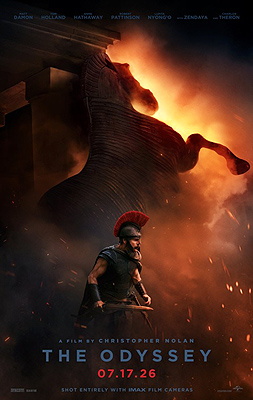
 The Odyssey (2026) ***
A time traveler from 2026 might find the turn of the 12th century BC surprisingly homey, provided that they landed in the Eastern Mediterranean with the wherewithal to pose as someone of relatively high status. The messy hodgepodge of city-states that formed during the early Bronze Age had coalesced by then into nine or so larger polities that prefigured in many ways the empires and nations of later eras. Literacy was widespread among the elite, as were travel and trade between territories. There were government bureaucracies supported by taxes and fees, courts of law settling disputes according to recorded precedents, and institutionalized diplomacy conducted in a common language known as Akkadian (originally the vernacular of a Babylon that was ancient even in those days). Most of all, the Eastern Mediterranean of 1200 BC had a startlingly integrated economy, even though money as we know it hadn’t been invented yet. International supply chains circulated Egyptian gold, Cypriot copper, Assyrian lumber, Mycenaean ceramics, and sometimes even Hittite, Kashite, or Mittanian grain all over the region, much of it in ships built in Canaan or Minoan Crete. Artists and ideas moved all over as well. In an example that I find inexplicably charming, wealthy Egyptians of the time fell in love with Mycenaean-style bull-jumping frescos, and started having them painted onto the walls of their houses. And that entire system was critically dependent on a commodity that wasn’t available within it in anywhere near the necessary quantities, for the Bronze Age Mediterranean was as hooked on tin from Afghanistan as the modern West is on oil from the Persian Gulf.
There’s a more ominous point of resemblance, too, between the milieu of 1200 BC and the milieu of AD 2026. Although the state of affairs I just described had chugged prosperously along for some three centuries despite the occasional disruptions of war, disease, and natural disaster, the preceding 30 years or so had exhibited signs of accelerating disintegration. By the time a child born in 1200 had reached their dotage, virtually every feature of the world they’d been born into would be gone. Of the nine major powers, only Egypt survived, and even it would take centuries to regain the power, wealth, and glory of its Bronze Age heyday. Smaller civilizations like Troy and Ugarit vanished so completely that educated people in ages to come could reasonably debate whether they’d ever existed in the first place outside the realm of legend. Great cities decayed into ruin, never to be rebuilt. Trade dried up. The Akkadian language fell into disuse outside of Mesopotamia, and its role as the tongue of law and kingship was gradually usurped by Aramaic even there. Literacy itself was forgotten in the Aegean territories. And what might be the most disturbing thing of all is that there’s no single, obvious calamity to account for the collapse. Instead, the cosmopolitan society of societies that flourished circa 1200 BC seems to have been undone by an overwhelming cascade of individually minor breakdowns, both natural and manmade.
Analysis of ancient pollen indicates the onset of a three-century drought similar to the one that did in the Anasazi on the other side of the globe 2500 years later. There’s also evidence that the four tectonic plates which come together in and around the Eastern Mediterranean were releasing a lot of pent-up stress, resulting in half a century of frequent earthquakes all across the region. Put those together, and you get crop failures, famines, and floods of refugees, tempting power-hungry kings to exploit the chaos by launching wars against their destabilized neighbors. Trade and travel became more hazardous and less rewarding, which put more pressure on already weakened economies by removing foreign inputs on which they’d come to rely. And winding like a blood-red thread through the whole tapestry of disorder were the Sea Peoples, a loose confederation of marauders from the north and west, whose destructive activities are attested again and again in the proclamations and communiqués of the late Bronze Age kings.
Mind you, the Sea Peoples didn’t call themselves that. Indeed, we can only guess at what they called themselves, or even at who they actually were. But two sets of inscriptions associated with the Egyptian pharaohs, Merneptah and Ramses III, provide some interesting lists of foreign invaders whom the kings in question repelled circa 1207 and 1177 BC respectively. Some of those ethnonyms are readily identifiable with known peoples of antiquity. When the pharaohs brag about defeating the Lukka, the Peleset, and the Shekelesh, we can be reasonably sure they’re talking about the Lycians, the Philistines, and the Sicels. Meanwhile, the Shardana (or Sherden) might be tentatively matched with the inhabitants of Sardis (a city near the west coast of what is now Turkey, later the capital of the Lydian Empire) or Sardinia. At the other extreme, the Tjekker and the Weshesh are completely mysterious, although various historians and archeologists have their pet theories. And then there are the Eqwesh and the Danuna (or Denyen), which brings me at last to the point of this opening ramble through ancient history.
The Archaic Greek poet Homer1 almost never used the term Hellenes, which is what the Greeks of his and later eras called themselves. Rather, when the Iliad and the Odyssey speak of the Mycenaean side in the Trojan War2, they’re generally called Achaeans or Argives or Danaans. So here too we see a link between the Sea Peoples and some familiar ancient ethnic group; it just takes an extra step or two to get there. From Danuna to Danaan, from Eqwesh to Ahhiyawa (the Hittite name for the folks on the opposite side of the Aegean Sea) to Achaeans, and thence to the Mycenaean precursors of the Greeks. Notice something, though. Mycenae fell, too, at around the same time as all the other big Bronze Age civilizations. If we credit the Sea Peoples as an important factor in the collapse, then to read Eqwesh and Danuna as Achaean and Danaan puts the Mycenaeans on both sides of the equation. I believe that’s a perfectly valid and reasonable interpretation of the evidence, but the last thing in the world that I expected from Christopher Nolan’s The Odyssey was to see that he evidently agrees. More than that, Nolan turns the Mycenaean contribution to the destruction of Mycenae into the central theme of the story, so that the homecoming of Odysseus and the other Argive heroes of the Trojan War becomes a cautionary tale of how easily and catastrophically the violence of war can accompany the warriors upon their return.
Twenty years ago, a woman named Helen (Lupita Nyong’o, of Little Monsters and Star Wars: The Force Awakens), reputedly the loveliest in the world, absconded with Paris, heir to the throne of Troy. Or perhaps it was Paris who absconded with Helen; Nolan pointedly leaves that rather important detail open to interpretation. But regardless of who absconded with whom, there was bound to be trouble over it, because Helen was married. Worse yet, she was married to Menelaus (Tom Bernthal), the king of Sparta. And even worse than that, Menelaus was kid brother to Agamemnon (Benny Safdie), the mightiest monarch on the whole western shore of the Aegean. When Agamemnon agreed to back his brother’s play to reclaim Helen, it meant leading all of Achaea into war against Troy. But because Troy’s fortifications were as impregnable as Agamemnon’s army was irresistible, the conflict quickly ground to a standstill. Only after nine years of fruitless siege did King Odysseus of Ithaca (Matt Damon, from The Great Wall and The Martian), wiliest of Agamemnon’s lieutenants, devise a stratagem to break the stalemate. To the Trojans’ astonishment, Agamemnon packed up his entire force and sailed away, leaving behind an enigmatic wooden horse, cobbled together from pieces of wrecked ships, along with a single man— Sinon (Elliot Page, of Hard Candy and Flatliners) was his name— charged with explaining that the equine colossus was an offering to the gods in the hope that they would grant easy passage on the return voyage. But unbeknownst even to Sinon, the horse contained an elite platoon of Danaan warriors led by Odysseus himself. When the Trojans honored the Argives’ gift to their common gods, dragging it into the city and erecting it in front of their own temple to Athena, Odysseus and his men sprang out under cover of darkness to open the gates of Troy. The same darkness had covered the return of Agamemnon’s fleet, and all of Troy was ablaze in no time.
That much is known in every Achaean city. What is less widely known are the evil fates that befell many of the Argive heroes after the war, and what nobody knows is what became of Odysseus. Ten years he’s been unaccounted for, while Telemachus (Tom Holland), the son who had just been born when Ithaca’s king set sail for Troy, grew to the threshold of manhoood. In all those years (to say nothing of the preceding decade of active warfare), the city has been under the stewardship of Odysseus’s wife, Penelope (Anne Hathaway, from Colossal and Interstellar), but the Achaean constitution won’t countenance a queen ruling in her own right. Thrones are for male asses only, and as consensus evolves among the leading men of Ithaca that Odysseus is never coming back, pressure mounts on Penelope to remarry. Thus for three years, the palace has played host to 108 suitors, who came from far and wide to compete for Penelope’s hand. The suitors’ persistence is more than merely irritating, for all those men require hospitality. Entertaining a hundred guests every night for three years is enough to strain even royal wealth— and indeed that’s become a deliberate strategy for the suitors. All Penelope need do is to marry one of them, and the rest will go back whence they came.
It’s all well and good for Antinous (a brilliantly slimy Robert Pattinson, from Curse of the Ring and Mickey 17), Polybus (Corey Hawkins, of Kong: Skull Island and The Last Voyage of the Demeter), and Peisander (The Purge: Anarchy’s Niko Nicotera), effectively the ringleaders of the suitors, to say that, but the fact is that neither Penelope nor Telemachus believes Odysseus is really dead. And one night, Athena (Zendaya, from Denis Villeneuve’s Dune trilogy) pays a visit to Ithaca disguised as a traveler from a distant city to inform the boy that he’s been right all along. The incognito goddess advises Telemachus to sail for Sparta with a handful of trusted retainers, and to hear what rumors Menelaus has collected about the returning Achaeans. The Spartan ruler turns out to have no news of Odysseus specifically, but he knows enough other tales of bad ends to heroes’ homecomings to redouble the mistrust with which Telemachus already regarded his mother’s suitors, and to secure him in his resolve that drastic measures against them are justified, if only he can contrive an opportunity to take them.
Now when I said before that no one knows what happened to Odysseus on his way back from Troy, I was including Odysseus himself! Although the long-lost king is indeed alive, his memory even of his own identity is a total blank, kept that way by the enchanted lotus blossoms which the sea nymph Calypso (Charlize Theron, of Mad Max: Fury Road and Apex) has been feeding him since he washed up on the shore of her island seven years ago. The drugging began as a mercy, for the storm-tossed stranger had plainly suffered too much ever to recover from his physical injuries unless his psychic wounds were anesthetized first. But as Calypso grew to love Odysseus, she also grew to dread the day when he would be sufficiently healed to leave her, and thus she has prevented him from remembering whatever might cause him to want to. Now, however, Calypso has repented of her subterfuge, and accepted that the time has come to help Odysseus regain his past.
Storytelling was one of the most important social activities of the ancient world, and it is therefore fitting that The Odyssey should spend the greater part of its counterproductively immense length on a nonlinear assemblage of flashbacks. It begins with a rhapsode (rapper Travis Scott) reciting the tale of the Trojan Horse for the feasting suitors, soon after which we learn with Calypso’s help that Odysseus himself recalls the incident somewhat differently. It flits back and forth thereafter between the things that Telemachus learns on his visit to Sparta and Odysseus’s recovered memories of his voyage— and all those recollections, on both sides, come as detached episodes rather than any single, continuous narrative. The audience is left to construct that for themselves, and there are clues along the way that not everything we see or hear is altogether trustworthy. There are even stories within the flashbacks, especially when Odysseus reaches the edge of the underworld to consult with the long-dead sage, Tiresias (James Remar, from Unnatural and Django Unchained), and meets as well the resentful shades of his fallen comrades in arms. And in point of fact, this was how Homer approached the material, too, although he put the pieces together in a different order, and related some of the anecdotes from different points of view.
As is often the case, the episodic structure works both for and against The Odyssey, which eventually starts to feel almost like an anthology film in which most of the segments have the same hero. The pinnacle of the movie’s effectiveness is the encounter with Circe (Samantha Morton, from John Carter and Minority Report), the witch who turns Odysseus’s crew into pigs. Ensorcelled food is the delivery system for the spell, but its direct effect is to render the men’s flesh and bones pliable enough for Circe to stretch, squish, and mold them into animal forms of her choosing. And the fact that she does choose makes it significant that the witch transforms this desperate, starving, nearly feral remnant of a plundering army into swine of all creatures. Nolan and Morton make Circe both fearsome and sympathetic, reminding us that for all her power, she’s still a woman alone with a literal boatload of armed men experienced in pillage and rapine. The plight of the crew is both viscerally horrifying and a triumph of special effects makeup and trick cinematography. And the words the witch coos to the hogs as she restores their human forms provide the flash of illumination in which we first see the thematic tapestry of The Odyssey entire: “Go on, now… Back into your disguises…”
The Cyclops and Tartarus episodes are exceptionally strong as well. Indeed, I’d go so far as to say that Nolan handles them better than did Homer himself. In the former case, Nolan reconciles Polyphemos’s dual status as man-devouring monster and beloved son of the Greek pantheon’s second-mightiest god by turning the encounter into a tragic collision between mutually unintelligible minds— indeed, between minds incapable at first of recognizing each other as such. And in the underworld sequence, he combines the psychological terror of dead friends standing in judgment over failures and betrayals that can no longer ever be put right with the starker, more primal menace of a pack of blood-hungry revenants. What starts as Bronze Age J’Accuse! ends with 28 Days BC threatening to break out at any moment!
Among the other fantastical segments, I’d put the Sirens on the next tier down, making up for the lack of drama with an unusually clever and thematically resonant interpretation of what their irresistible song actually is. Scylla and Charybdis I’d rank one more notch lower, partly because Scylla could be so much more than a generic tentacle monster, but also because Nolan elides the point (which I’ve always found ineffably disturbing) that Charybdis is also supposed to be a malign living thing, of which the ship-swallowing maelstrom is merely the manifestation visible from the surface of the sea. The turkey among the fantasy adventures is the isle of the Laistrygones, where Odysseus and his men just get their asses kicked by ten-foot dudes in anachronistic suits of armor, like they’re losing the stage-five boss fight in Golden Axe.
Homer’s Odyssey wasn’t really about the bizarre dangers that its hero faced en route from Troy to Ithaca, however, and neither is Christopher Nolan’s. For Homer, the point was how Penelope’s suitors were gaming the system that makes civilization possible in the first place, and the tale of the voyage proper therefore occupies just four cantos out of 24. Nolan, despite recognizing the cinematic value of Odysseus’s adventures, and rebalancing the film accordingly, follows the poet’s lead in treating them all as mere obstacles. But whereas Homer presented the suitors as strictly Ithaca’s problem, Nolan turns them into a microcosm for something much larger and more insidious— the focal point in a portrait of a society corrupting its foundational values at scale, and inviting its own destruction in the process.
I need to pause here to emphasize the distinction between rejecting old values and corrupting them. It’s one thing for a people to recognize that their ideals have failed, or have become outmoded, or were moral mistakes in the first place, and to replace them consciously with new ones that are hopefully more fit for purpose. That’s how cultures grow and adapt to changing circumstances, and a society that can’t reevaluate when necessary is doomed. It’s something else again, though, for a society to continue paying lip service to its ancestral values while emptying them of meaning, turning them inside out, and puncturing them with exceptions until they cease to operate at all in practice. A society that does those things commits a kind of treason against itself, opening itself to different but no less deadly forms of decay and collapse.
Characters in The Odyssey talk constantly about “the Law of Zeus,” by which they mean the obligation to welcome the stranger who comes humbly seeking succor from the hazards of the wilderness. On the one hand, it’s a practical matter, because gods often go in human guise when conducting their business in the mortal realm, and it wouldn’t be prudent to snub Apollo when he shows up on your doorstep asking to spend the night. But it’s also an acknowledgement that humans need each other to survive, and that the only way for civilization to function is for us all to extend to strangers in need the same mercy and compassion that we naturally grant to family and friends. Christopher Nolan didn’t just make that up. Not only was it a real concept in ancient Mediterranean culture, but one so powerful that Homer could write of Odysseus invoking the law of hospitality before the daimon of an unknown river, beseeching it to slack its current so that he could make landfall safely! In Nolan’s telling even more than Homer’s, The Odyssey is a cavalcade of bad hosts and bad guests, fraying the social compact of Zeus’s Law to tatters for their own selfish ends.
Crucially, that indictment includes even Odysseus himself. His trick with the wooden horse exploited the Trojans’ worship of the same gods as the Achaeans, winning victory for Agamemnon at the price of a sacrilege literally inconceivable by less devious minds. Starting with Odysseus already guilty in the sight of Zeus explains why his voyage home is so hopelessly cursed from the get-go, even before he and his men start pissing off additional deities during their various stopovers. It ties his misfortunes directly and completely to his conduct, rather than rooting it at first in the gods’ capricious side-taking during the Trojan War. Also, if I’m assembling the flashback vignettes in the correct order, Odysseus now becomes Athena’s special favorite only after his years of suffering cause him to start rethinking both his own role in the war and that of the Argives generally.
That leads me to my favorite of the unexpected choices that Nolan makes in The Odyssey: his portrayal of Agamemnon and Menelaus. Homer treated both sons of Atreus as straightforwardly heroic figures— although doing so reveals how far his culture’s concept of heroism differed from ours. Nolan’s approach, on the other hand, is polyphonic. His royal brothers are unquestionably heroes in the eyes of all the other characters, but something else again from our perspective. The most shocking moment in the whole film comes when Menelaus introduces Helen to Telemachus. Telemachus is seated at his host’s right hand when Helen enters from behind them to sit down on her husband’s left, so that we and Telemachus alike can see only her right profile. Taking her affectionately by the chin, Menelaus turns to his guest and says, “The face that launched a thousand ships… Well, maybe only 500 now.” And with that, he wrenches Helen around to reveal the hideous scar that disfigures the left side of her face, luridly pink against the rosewood brown of her cheek. And while no one ever says so, it’s plain enough from his satisfied smirk that Menelaus gave her that scar with his own hand.
As for Agamemnon, he’s largely a symbolic presence, which is fitting enough since we begin with him already dead. For the Achaeans, he embodies righteous authority and the beginnings of imperial power, and the bad end to which he came epitomizes the looming dangers to both those things that have been springing up all over ever since the fall of Troy. But with his black armor and face-masking helmet, Nolan’s Agamemnon looks like a perfect Bronze Age Darth Vader, and his appearances in flashback are often composed as echoes of Vader’s scenes in the original Star Wars. We’re talking Rod Serling levels of unsubtlety here, but it’s a potent visual reminder that evil empires are the only kind that have ever really existed. Agamemnon comes to stand for something else, too, as it grows increasingly clear what we’re to make of all the ominous incidental talk of sea raiders terrorizing coastal cities across the Aegean. Those raiders are the surviving veterans on both sides of the Trojan War, who after a decade of incessant, no-quarter fighting are incapable of living any other way. And as the architect of that war, waged for his brother’s sake over mere sexual jealousy, Agamemnon in its aftermath personifies the culture-wrecking folly of military adventurism. That he and Menelaus are still regarded as heroes anyway shows exactly how far the value-rot in Achaea has progressed.
Home Alphabetical Index Chronological Index Contact
