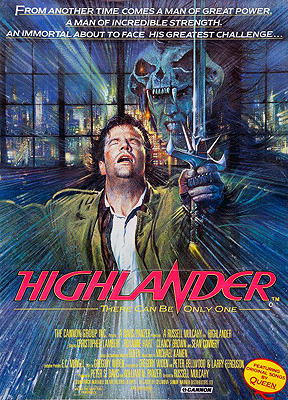
 Highlander (1986) -***
Imagine that it’s 1986, and you’re making a movie called Highlander. Of course you’re going to cast Sean Connery, right? I mean, the Highlanders are the Scottiest of all Scots, and Connery was easily the most Scottish guy in Hollywood in those days. And naturally you’re putting Connery in the title role, aren’t you? Like, it would be obviously insane in a movie called Highlander to sideline him as a Spaniard or an Egyptian or some shit. I’m sure you see where this is going, though. There is indeed a movie from 1986 called Highlander; it does indeed have Sean Connery in a major role; and it does indeed cast him as an Egyptian impersonating a Spaniard. So who plays the Highlander if not Connery? Fucking Christopher Lambert, second only to Louis Jourdan among 1980’s Hollywood’s Frenchest Frenchmen! And then the extremely American Clancy Brown plays a Eurasian steppe nomad, while the unmistakably British Sheila Gish plays a Low Countries Jew, because why the fuck not at that point? This recursive tanglefuck of misaimed nationalities (and the accents that go along with them) subliminally sets the tone for the whole film, which is as gleefully nutty and stridently nonsensical as anything else the Cannon Group released during their mid-80’s heyday. But because Russell “Razorback” Mulcahy is in the director’s chair, Highlander is so over-the-top stylish that it’s surprisingly easy to excuse its empty skull and cocaine-encrusted moustache.
Manhattan antique dealer Russell Nash (Lambert, from Shadow of the Wolf and Fortress) is watching a wrestling match at Madison Square Garden, and thinking about a day in 1536 when Connor MacLeod— a Highland clan chieftain who looked just like Nash, only hairier— led his kinsmen into battle against a rival laird. Suddenly, a feeling comes over Russell. He gets up out of his seat, leaves the arena, and heads down to the parking garage, where he is called out by an aging Englishman whose face appears to have been sculpted out of rare roast beef (Peter Diamond, who played similarly small but conspicuous roles in The Face of Fu Manchu and The Pleasure Girls). Both men draw swords from places on their persons where no sword could be, and proceed to duel until Nash beheads Beef Bloke. Somehow this causes lightning to discharge all over the place while every car on that tier of the parking garage spontaneously explodes.
Naturally Nash would rather not try explaining any of that to the police who are sure to come running in response to the disturbance, but all the wreckage slows his escape sufficiently that he’s picked up right at the exit to the garage. Luckily, though, he had the forethought to hide his katana (it’s 1986— of course Russell has a katana!) before attempting to flee. The only weapon found by the cops is Beef Bloke’s Spanish-style broadsword, from which Nash’s fingerprints are unmistakably absent. Lieutenant Frank Moran (Unholy Matrimony’s Alan North) might hold him a few hours for questioning, but can’t give him anything worse than a speeding ticket based on the evidence at hand. Make no mistake, though— the NYPD will be keeping an eye on the antique dealer going forward. This is the third decapitation murder in greater New York in the past month, and the tabloids are starting to salivate about a “Headhunter” killer. But if you’re asking me, Moran would do better to monitor the fleapit hotel where a guy who looks like a cross between Peter Steele and Leatherface’s kid brother (Brown, from The Bride and The Adventures of Buckaroo Banzai: Across the 8th Dimension) just checked in. The only reason why there are no severed body parts in that dude’s luggage is because he didn’t bring any beyond the carrying case for his ludicrous modular bastard sword.
It’s an improbably good thing for Moran that the head of forensics at his precinct, Brenda Wyatt (Roxanne Hart, of Deadly Lessons and Pulse), has a sideline interest oddly relevant to the developing Headhunter case. She’s such an expert on historical swordsmithing traditions from around the world that she has a published book on the subject! Wyatt instantly recognizes the blade from the garage as a Salamanca broadsword of the 16th century, made from Toledo steel, and reckons its value at roughly $1 million given its almost unheard-of combination of age and condition. She also quickly rules it out as the murder weapon on metallurgical grounds, which leads her back to the crime scene to look for traces of a second sword. Nash has retrieved his katana by then, but he left flakes from its edge in a concrete pillar during the fight, and Wyatt finds and analyzes those. This time, her findings have even stranger implications than a sword that someone kept in viable fighting condition for 400 years: a steel blade forged with Japanese metal-folding techniques from the Tokugawa period, but bearing the isotopic signature of iron from the 6th century BC! The prominence of antique swords in the evidence surrounding the Headhunter case leads Wyatt to agree with Moran that Russell Nash is probably tied up in it somehow, but at this point, she’s honestly more interested in him from a hobbyist’s perspective than a professional one. She wants to know whatever Nash does about these seemingly impossible old weapons. Adopting the guise of a museum curator seeking advice on some unusual artifacts, Brenda begins scoping Russell out on her off hours. Her cover isn’t half as good as she imagines, however, because Nash owns a copy of her book.
Meanwhile, Russell keeps having flashbacks to the life of Connor MacLeod, which means it’s time for some answers around here. That battle Nash was thinking about during the wrestling match at Madison Square Garden? It should have ended with MacLeod’s death at the hands of (would you look at that?) a dead ringer for the psycho with the modular bastard sword. When Connor mysteriously failed to die from being run through, his kinsmen, his neighbors, and even his wife (Celia Imrie, from Mary Shelley’s Frankenstein and The House of Whipcord) cast him out, convinced that his corpse had been possessed by a devil. After much wandering, MacLeod took up residence in an abandoned keep overlooking a remote valley, together with a girl named Heather (Beatie Edney). They were happy in their solitude, but one day a fop calling himself Juan Sanchez Villalobos Ramirez (Connery, from Sword of the Valiant and Outland) came calling with strange and disruptive tidings. MacLeod was able to survive being stabbed through the liver because he belonged to a rare race of immortals. Only decapitation could kill him. Ramirez knew this because he was immortal, too— and so was the man who skewered MacLeod. Indeed, that guy was the mightiest of all the immortals, so ancient that his true name was forgotten. Everyone just called him “the Kurgan,” after the extinct Proto-Aryan steppe tribe to which he once belonged. The really important thing, though, was that an immortal who slays an immortal absorbs both his lifeforce and all his vaguely defined superpowers, creating an incentive to do just that. Meetings between immortals therefore tend to end in beheadings.
Ramirez was built different, however, so he befriended Connor instead of bisecting him, and taught him everything there was to know about their condition— including the importance of switching up their claimed identities every few decades, and moving frequently from place to place in order to forestall the neighbors from wondering why that guy down the block never seems to age. Yeah, you’ve got it. Russell Nash is really Connor MacLeod, the Headhunter is really the Kurgan, and the latter has been deliberately exterminating his own kind in the hope of becoming the very last, for immortal lore has it that that final One will reap some unimaginable metaphysical boon. Obviously Connor and the Kurgan will be meeting again one of these days, and woe betide any human (like, say, Brenda Wyatt) who gets caught in the middle when it happens.
Frankly I’m surprised at the lot of you. No judgment, you understand— I mean, there was a time when the most frequently rewatched movies in my collection were The Bare-Breasted Countess and Zombie Lake— but it’s rare for a film this flagrantly stupid to become the particular species of cult favorite that Highlander has. Despite performing anemically at the box office, it gained enough of a following on cable TV and home video that even the legendarily awful sequel that hit theaters in 1991 represented only a momentary stumble on the road to Franchise City. As of this writing, there have been four theatrically released Highlander films, two Canadian television series sold straight into international syndication, a made-for-TV movie capping off the longer-running of those shows, a Franco-Canadian cartoon for the after-school market, and a feature-length anime spinoff. There’s also a projected remake that’s been stuck in Development Hell since 2008. Most of those manifestations are neither quite in nor quite out of continuity with each other, and retcons abound even in the core quartet of full-fledged movies. Nevertheless, Highlander is now a persistent if easily overlooked feature of the pop-culture landscape, in ways that very little else bearing the Golan-Globus brand ever became. I’m tentatively assuming that makes more sense on the basis of developments subsequent to Highlander 2: The Quickening, because judging from the two entries I’ve actually seen, one might just as well posit a Firewalker cinematic universe.
The main source of my bafflement in the face of Highlander’s “Star Trek”-like afterlife is that not one aspect of this fictional world will stand the slightest interrogation or scrutiny. It sounds straightforward enough the way I’ve just described it, but that’s because I skipped over all the stuff that demands explanation, but never receives it. I didn’t really go into the Quickening, the Gathering, the Game, or the Prize, concepts that collectively seem to underpin all of immortal society, but about which the movie is maddeningly silent regarding how any of them are supposed to work. I didn’t mention that immortals are incapable of breeding, which needlessly dials up the angst in Connor’s relationship with Heather while calling the maximum possible attention to the unacknowledged mystery of how or why immortals arise in the first place. I didn’t enlarge upon the concept of immortal superpowers, because the only one that the film is remotely consistent about is their ability to sense each other’s presence. Sometimes, but not always, they’re superhumanly strong. Sometimes, but not always, they’re psychic empaths. Sometimes, but not always, they can apparently project their consciousness into the brains of non-human animals, and use that connection to gain access to non-human abilities. Well, okay. I suppose Higlander is also consistent about the immortals’ propensity in death for making everything within a hundred-yard radius blow up real good— but if that’s the case, then don’t you kind of have to wonder how they’ve kept their existence a secret from humanity for so long? Shouldn’t a species that can’t die without setting off an HO-scale Tunguska blast attract more attention, even if they normally don’t die all that often?
But while the underdeveloped lore perplexes me, it isn’t what bothers me about Highlander. Opacity, after all, can be a valid storytelling choice, and it’s one that I’m even coming to appreciate in a media environment where over-explanation is by far the more prevalent sin. It would be much easier for me to roll with the lacunae if any of the immortal characters made the slightest bit of sense as characters. Let’s start with Connor MacLeod himself. Honestly, it annoys me that this movie is even called Highlander, since MacLeod’s national origin is not merely the least important or interesting thing about him, but actually something that his status as an immortal is explicitly meant to transcend. When the Kurgan’s sword-thrust failed to kill him that day in 1536, all human categories ceased to apply; Connor became whatever the fuck the immortals are, and only that, forevermore. Indeed, one possible way to read MacLeod’s subsequent development is as the futile defiance of that destiny across six lifetimes, as he strives to hold onto some semblance of humanity despite everything. It would explain, for example, why Connor never stops trying to make new connections with mortals even after Heather grows old and dies, like when he rescues a little Jewish girl from the Nazi advance through what I take to be Belgium or the Netherlands, effectively adopts her, then retains her as his secretary after she matures into the aforementioned Sheila Gish. But if that was what director Russell Mulcahy or any of the three credited screenwriters intended, it never quite manages to cut through the noise. And of course it doesn’t help that Christopher Lambert spoke almost no English yet in 1986, and had to memorize all his lines phonetically. Like I’m not sure a lead who understood what he was saying could have done anything with the totally unmotivated romance that eventually breaks out between Connor and Brenda, but at least he’d have had a chance.
Ramirez is even less coherent, thanks primarily to his role as MacLeod’s mentor. A better movie might have gotten some use out of the irony that the person who teaches Connor the ins and outs of the immortal way of life consistently refutes most of his teachings with his own conduct, but I see no evidence that the makers of Highlander even noticed that going on. And as with MacLeod, it would have taken very little effort to fix the character. Draw a clear link between Ramirez’s doomed marriage to a mortal and his current rejection of his fellow immortals’ singleminded pursuit of each other’s heads— hell, make that rejection an overt and avowed thing in the first place! Connect his sojourn in Japan to his self-assigned mission as MacLeod’s sensei, instead of just using it to set up a bullshit origin story for Connor’s sword. Make Ramirez’s roots in ancient Egypt matter in some concrete way, rather than letting them call unwanted attention to Connery’s miscasting every time he opens his mouth or somebody else utters his name.
The Kurgan is the character who frustrates me the most, however, because Clancy Brown seems to have swaggered into Highlander from some other and altogether superior movie. Ironically, this was reportedly not at all the performance that Brown wanted to give. He saw the Kurgan as a sad and world-weary figure, whose monomaniacal obsession with the Prize stemmed from his having outlived everything he ever cared about a hundred times over. That would have been equally engaging in its own way, I’m sure, but this indestructible goth-punk psycho-killer is the movie’s most memorable and entertaining feature. The trouble is that the performance and the script are out of synch. If the Kurgan is going to be an even crazier cousin to Cobra’s Night Slasher, then he ought to be an even bigger nihilist. The way Brown plays him, it’s impossible to believe this bastard honoring a taboo against spilling blood on sacred ground, or giving Connor a remotely fair chance to rescue Brenda.
Thus far, this has mostly been my cerebral cortex talking, and as I hope I’ve made clear, it wasn’t impressed with Highlander one little bit. My limbic system, on the other hand, dug the hell out of this movie, for it represents one of the few basically successful attempts to tune a Continental European “the style is the substance” sensibility to the tastes of an American pop-culture palate. I first encountered Highlander on MTV, via the video for Queen’s characteristically execrable theme song, “Princes of the Universe,” and the actual film is esthetically very much like a music video engorged to a 112-minute runtime. It’s glitzy, flashy, hectic, dazzling, and unabashedly unreal, and it never, ever, ever refrains from doing something that looks cool as shit just because it happens also to be idiotic. Let me give you some examples of what I mean by that last part. You know the scene that figures in practically every movie featuring an assassin who isn’t a ninja, wherein he unpacks and assembles his sniper rifle in a dingy hotel room? Well, that’s just what happens the first time we see the Kurgan in the 20th century, except that he unpacks and assembles his bastard sword. It looks badass, but the thing is, you really can dismantle a rifle into as many pieces as you want, provided that one of them is a complete barrel. Put a screw joint halfway up the blade of a sword, however, and another one where the blade meets the hilt, and congratulations— you’ve invented a weapon absolutely guaranteed to snap into three pieces the first time someone parries your swing. Similarly, one of the duels between immortals has the combatants literally cutting down a Dark Ages castle as they fight, even though nothing else in the film suggests that either of them could possess that level of physical strength. But would a twelve-year-old boy exclaim, “Dude! Awesome!!!!” upon seeing such a thing? Then Russell Mulcahy’s work here is done. And maybe that explains why I’m not fully in the tank for Highlander, now that I think of it. I’m apparently the only Gen-Xer on Earth who didn’t see it for the first time when he was twelve years old.

Home Alphabetical Index Chronological Index Contact
