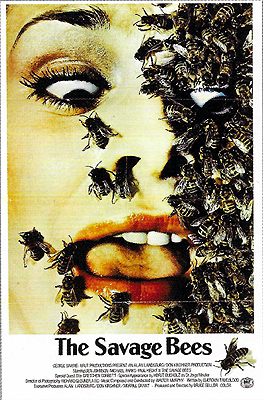
 The Savage Bees (1976) **½
We already covered the origin of the 1970’s “killer bee” scare when I wrote up The Swarm, so I won’t retread that territory now. It is worth noting, though, that the movies exploiting that anxiety kind of ran their phylogeny backwards. Irwin Allen’s star-studded, big-budget treatment of the subject was one of the last out of the gate. Not only did the cheapsters get there sooner, but the first B-movie bee movie to deal directly with the menace of Africanized honeybees, unadorned by sci-fi or supernatural overlays, was made for broadcast television (although it won theatrical release, too, in various foreign markets). And rather surprisingly, The Savage Bees is a fairly nimble little thriller, hampered only a little by network squeamishness and a cramped budgetary ceiling. Best of all, its bees are the real deal whenever possible, instead of the expected clouds of fan-blown breakfast cereal or brown confetti.
The setting is New Orleans, so inevitably it’s Mardi Gras. The Carlina Rios, a 700-ton reefer boat laden with bananas and flying the Brazilian flag, blunders into the path of a massive commercial freighter (note that although the big ship bears the name Marganite in the stock-footage establishing shot, the freighter actually hired by the producers for the scenes set aboard and around it has the altogether more apropos handle Eastern Hornet), and is smashed to bits. Strangely, though, no bodies are recovered from the wreckage despite a subsequent telegram from the vessel’s owners indicating a crew of ten. And weirder still, the freighter’s first mate and quartermaster go missing, too, in the aftermath of the crash. One of the latter is found dead in the mud of the Mississippi Delta after a quick search, and when his corpse is brought aboard, the face is disfigured by an alarming rash of swollen lesions. Was the Carlina Rios some kind of plague ship?!
Meanwhile, Orleans Parish sheriff Donald McKew (Ben Johnson, from Cherry 2000 and The Town that Dreaded Sundown) has just set off for work when he spots his dog lying dead by the side of the road. The animal’s condition— puffy and swollen, but unmarked by anything McKew recognizes as a wound— suggests poison to the sheriff’s way of thinking, and he goes a tad haywire. McKew barges into the Orleans Parish coroner’s office raising all sorts of hell, demanding an immediate autopsy on the slain mutt. After settling down and renegotiating in a saner tone, McKew secures the cooperation of assistant medical examiner Dr. Jeff Du Rand (Michael Parks, of Night Cries and The Evictors), but the results of Du Rand’s investigations are the last thing either man expected. There’s poison in the dog’s system, alright, but it’s honeybee venom. Every one of the swollen welts on its skin has at least one stinger embedded in it, and there are even bees inside the animal’s stomach!
Du Rand immediately places a call to his ex-girlfriend, Dr. Jeanne Devereaux (Gretchen Corbett, from Jaws of Satan and She’s Dressed to Kill). That’s because Devereaux isn’t a medical doctor, but an entomologist. She’s extremely unhappy to hear from Jeff at first, but sets aside her aggrieved attitude as soon as he asks her whether bees could kill a dog. Jeanne’s off-the-cuff answer— “They could, but they wouldn’t”— gives way after a moment’s reflection to the horrified realization that some bees absolutely would. And since the dead sailor from the crash in the Mississippi River shipping channel has reached Dr Rand’s office as well, there’s now an obvious mechanism whereby the vicious tropical insects could have reached New Orleans. Devereaux calls Dr. Rufus Carter (Paul Hecht) at the National Bee Stock Center, and alerts him that the contingency he’s been planning for since the 1960’s has finally come to pass. Then Carter in turn contacts Dr. Jorge Mueller (Horst Buchholz, of Aphrodite and Dead of Night) in Brazil to seek his expert assistance. Carter also impresses upon Du Rand the importance of treading lightly in getting the word out, because if panicked ignoramuses start killing bees on sight the way they started killing sharks after that movie came out last summer, the consequences for agriculture could be catastrophic.
That’s all well and good, but Mueller can’t make it to New Orleans until tomorrow, and in the meantime, those bees are dealing agonizing death all over Orleans Parish. Some of the victims leave behind survivors who want to know what the hell happened to their loved ones. Also, McKew is chasing the deadly bugs all over his jurisdiction, and there are only so many times a sheriff can show up asking about bees, of all things, before people start to talk. And nobody in the city government whom Du Rand and Devereaux try to warn, from the dispatch officer at the municipal police department (Bruce French, from Curse of the Black Widow and Christine) to the goddamned deputy mayor (James Best, of Death Mask and The Killer Shrews), seems to take the situation seriously.
A lot of things about The Savage Bees snapped into place when I realized why I recognized the name of producer/director Bruce Geller. Geller had been the showrunner for “Mission: Impossible,” giving him years and years of experience making something from not much at all. If he could turn the Paramount backlot into four continents’ worth of Third World and Eastern Bloc trouble spots, imagine what he could do if you actually sent him to New Orleans! Despite having been made for a fraction of the cost, The Savage Bees falls only trivially short of The Swarm in terms of production value, with only the initial crash in the shipping channel (conspicuously lacking a money shot of ships colliding) revealing how cheap it really was. The most attention-getting example of Geller knowing where and how to spend the money comes at the climax, which takes place inside the newly opened Superdome football arena, but the most effective one was the decision to hire some beekeepers, their swarms, and a core cast willing to risk getting stung. There’s simply no adequate substitute, in a movie about killer bees, for a few thousand live insects, and their impact is as potent whether the viewer greets them with fear or with fascination.
Another unexpected commonality between The Savage Bees and “Mission: Impossible” concerns the personalities of the central characters and their approach to the problem posed by the bees. “Mission: Impossible” was probably 20th-century television’s foremost example of a sensibility that I think of as “adults good at their jobs.” If it isn’t immediately obvious what I’m talking about, think of it as the trope diametrically opposed to the loose cannon who gets results. In Sheriff McKew and the entomologists, The Savage Bees has a group of adults who are very good indeed at their jobs— but the movie takes the unusual step of keeping them stymied at every turn by official indifference and incompetence until they get sufficiently fed up to let loose cannon Jeff Du Rand take the lead. Having gotten to know New Orleans a bit since my brother and his family moved down there a few years back, I find the film’s vision of a city devoid of give-a-fucks entirely too believable. NOLA gonna NOLA, as the locals say.
Now I said earlier that The Savage Bees was hampered somewhat by the squeamishness of broadcast television’s 1970’s censorship regime, and I mostly stand by that position. I should emphasize, however, that that applies only to what the movie shows onscreen. Offscreen is an entirely different matter! Any film that kills both a dog and a child in the first act is playing rough indeed by 70’s TV standards, even if we never see the bodies up close, and are shown only the lead-up to the attack. That too is a trick that Geller seems to have learned on “Mission: Impossible,” the early seasons of which featured some truly vicious and cold-blooded bad-guy comeuppances implicitly unfolding elsewhere while the heroes drove off into the closing credits. The death of the little girl (Tiffany Gautier Chase) certainly scared the crap out of me when I was about the same age as her, watching The Savage Bees with the real-world killer bee scare thrumming softly but steadily in the news media. That scene and its aftermath aren’t nearly as powerful seen through adult eyes, but I have to give props to The Savage Bees for going there at all.

Home Alphabetical Index Chronological Index Contact
