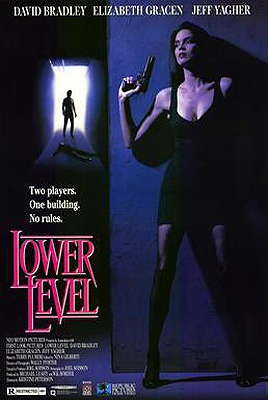
 Lower Level (1991) ***
A friend of mine who’s been reading this site for many years asked me if, by teasing a Kristine Peterson movie in this update, I was hinting at a review of Body Chemistry. It was a very good guess, wrong though it was. Body Chemistry, after all, was an important early example of the mature direct-to-video erotic thriller, and I’ve been nibbling around the edges of that under-examined genre for a while now. But Peterson also helped establish another strain of suspense picture that rose to prominence in the 1990’s, one that has attracted even less critical attention than the erotic thriller. Indeed, these films have been so roundly ignored that the type doesn’t even have a generally recognized name. I think of them as Rich White People in Peril movies.
That’s a rather snide term, I realize, but I don’t think anything else really gets at the essence of these things. They take a few different forms with regard to plot structure, characterization, and the specific nature of the threat, but they all focus on someone who has it all— money, status, professional respect, a solid reputation among their peers— being targeted by a psycho whom they, in their comfortable complacency, allow to get dangerously close. If the protagonist is male, you can almost count on him being a family man; if she’s female, expect a single woman with impressive accomplishments in a traditionally masculine career, or perhaps a luminary in the arts. The psycho can be any sort of person at all (even a child!), but their defining feature is a relationship with the protagonist that hinges somehow or other on trust— often on terms that encourage or at least allow the latter to think of themselves as helping the former. The shape of the story depends on whether or not the psycho gets what they want from the protagonist on the first try. If so, the villain will exploit their benefactor ever more egregiously, until some breaking point finally switches the relationship over into open antagonism. If not, the villain will be driven by a sense of betrayal, seeking revenge against the protagonist for letting them down. And as you can probably already see, a persistent subtextual message of the Rich White People in Peril movie is that the winners of life’s lotteries expose themselves to terrible risks by being anything but the most flagrantly selfish bastards. It’s a mistake, though, to read the genre reductively as a collection of Randian cautionary fables, because that reactionary tendency is juxtaposed more often than not against a recognition that the audience enjoys seeing people who want for nothing getting taken down a peg. Also, it’s worth noting that quite a few Rich White People in Peril films are perfectly clear-eyed about their protagonists being entitled pricks, and may even explicitly depict their backfiring generosity as condescension in disguise. That ambivalence mirrors, albeit along different axes, the paradox at the center of the erotic thriller, which contrapuntally revels in sex while portraying it as the most hazardous of all pastimes.
As usual, you can find early harbingers of the Rich White People in Peril film from previous movements in suspense cinema, especially in the 1960’s. Cape Fear is an obvious example, and Kitten with a Whip might be an even better one. Looking way back, we might even consider Night Must Fall in this light. And continuing the parallelism between Rich White People in Peril and erotic thrillers, Fatal Attraction pulls double duty as an important stage in the development of both. But so far as I can tell, it was Martin Scorsese’s remake of Cape Fear that really got the ball rolling, leading to, if not a flood, then at least a steady, years-long stream of movies like The Hand that Rocks the Cradle, The Good Son, and Fear. What makes Peterson’s Lower Level stand out so in that company is that it was released straight to video, whereas for the most part Rich White People in Peril were a theatrical phenomenon. After all, it’s difficult to create a believable milieu of wealth when the production company itself doesn’t have any.
The imperiled rich white person in Lower Level is architect Hillary White (Elizabeth Gracen, from Sundown: The Vampire in Retreat and Lisa), although she herself isn’t quite convinced that she has it all. Her boyfriend, Craig Fulson (Jeff Yagher), is an even bigger workaholic than she is, which means that they see very little of each other most weeks despite living in the same tony district of the same city. White would never say this to anyone but her diary, but it’s getting to the point where she suspects that Fulson will always love the thrill of the deal-making chase more than he loves her. Unbeknownst to Hillary, however, she does have at least one other admirer. The night-shift security guard at the building where she works— a building which she herself designed, incidentally— is a fellow by the name of Sam Browning (David Bradley, of Total Reality and Cyborg Cop), and Sam has fallen hard for the architect in Suite 1407 from his post down in the main lobby. But since it just so happens that Browning is an obsessive psychopath, White would really be better off without his affections, even if she knew about and returned them.
The movie takes place over the course of a single night, which begins for Hillary when Craig meets her come quitting time not at the restaurant where they were supposed to have dinner together, but at the entryway to her building’s subterranean parking garage. Something’s come up with an important client, so Craig will have to skip dinner and catch up with Hillary at her apartment later. White is pissed, but it turns out that Fulson isn’t actually going anywhere just now. It’s well past the office tower’s official closing time, and while the couple have it out over Craig putting work before romance yet again, the garage security gate rattles down, trapping them both inside. Also, the elevators seem to have stopped running, and Hillary is unable to raise anybody at the security desk on the intercom system. Seeing no other way to fill the time until somebody notices them locked in the garage, Hillary and Craig retire to the back seat of her car to have makeup sex. It is, after all, much more comfortable than his Jeep Wrangler.
Funny thing about that, though; The reason why the couple got sealed up in the first place was because Sam saw them on one of his closed-circuit television monitors, got jealous, and locked down the garage to give himself time to ponder what sort of move against Craig was called for under the circumstances. While he’s thus pondering, Hillary has a brainstorm that almost takes the matter out of his hands. Clambering onto the tallest of the nearby vehicles, she holds her cigarette lighter directly under one of the sensor nodes for the fire-suppression sprinklers, triggering both them and the fire alarm. Browning must not only shut off the sprinklers manually, but also call both the fire department and the company that maintains the sprinkler system to report a false alarm. That seems to make up Sam’s mind for him. He needs to get Craig out of the way now, and the best way to do that is to lure him into some kind of deathtrap while Hillary waits for her clothes to dry. Sam gets on the intercom, bullshits up a mechanical explanation for the couple’s travails so far, and announces that the elevator is working again. Then he arranges for the one that Craig summons to be on a different floor when the doors open at garage level, and Fulson trustingly steps on through.
Even that isn’t quite enough to get Sam and Hillary alone together, though, for White wasn’t the only one working late tonight. There are also a haughty executive (Sherri Shattuck, from Desert Warrior and The Naked Cage) and her meek personal assistant (Hellroller’s David H. Sterry), who seal their own doom by insisting on being allowed into the garage rather than accepting Browning’s apologetic offer to call them a cab. Then there are the two technicians from the sprinkler maintenance company (David Wolfe and Eric Fleeke, the later of Animal Instincts II and Campfire Tales), whose contract stipulates the immediate investigation of any false alarm. Only with them all dead and their bodies all hidden can Sam at last release Hillary from the garage, and set in motion the “serendipitous” romantic evening with her that he’s been fantasizing about for who knows how long. Of course you realize that he won’t be able to keep his cool once the object of his obsession declines to be swept off her feet…
The highest compliment that I can pay to Lower Level is that only the cast of 1990’s TV people gives it away as a direct-to-video release. Cinematographer Wally Pfister would later become famous (or as famous, anyway, as cameramen can aspire to be) as Christopher Nolan’s go-to guy, filming Insomnia, Inception, and the Dark Knight trilogy. You can already see his potential here. Instead of the cheesy daytime television finish that one encounters so often in VHS originals, Pfister brings to the project consistently atmospheric lighting, imaginative camera setups, and a conspicuous overall appreciation for the idea that looking at a movie should be at least as enjoyable as watching it. The film’s sound is unusually good, too, with none of the expected tinniness to be heard anywhere in the dialogue, music, or audio effects. It’s frankly amazing what a difference it makes that Lower Level’s creators simply treated it like a real movie, and not just as disposable rental shop shelf-filler.
A similar benefit accrues to Lower Level from the canny decision never to leave the office building. I said before that funding limitations made it hard to pull off Rich White People in Peril in the made-for-video realm, but this movie shows that the problem lies mainly in the domestic setting. People with lots of money buy big, stylish (or at least wannabe-stylish) houses, and fill them with expensive shit, but an office is pretty much an office. By sticking to the work environment, Peterson turns an impossible set-decorating challenge into a completely manageable question of location scouting. Find her the right office tower, and she’s good to go.
With just one location and three major characters (Craig turns out to be not as dead as he initially appeared), Lower Level takes on a kind of sinister intimacy that well befits the story of a woman squaring off against a lovelorn nutcase. Of course, that also means asking a lot of the actors playing that core trio, and the results here are markedly variable. Elizabeth Gracen comes out by far the best. For the purposes of this story, the salient fact about Hillary White is that she imagines for roughly half the film that she’s having a completely different sort of crisis than the one actually engulfing her. However smart and resourceful she may be, she thinks she’s dealing with a relationship coming unglued while glitches in her workplace security system thoroughly ruin the rest of her night. A psychotic secret admirer wasn’t on her radar at all. Gracen credibly portrays White as more flustered than anything else when Browning reveals his fixation on her, only gradually waking up to the fact that she’s in real danger, and taking even longer to perform the mental system-reset necessary to cope with the threat. And commendably, Gracen’s performance throughout the back half of the film retains a subtle note of disbelief, as if some deep-seated part of Hillary never does manage to get past “Okay, but where the fuck did this come from?!”
Jeff Yagher doesn’t acquit himself nearly as well in the part of Fulson. It’s okay that he comes across as a drip and a tool toward the beginning of the film, because that’s pretty much the point of Craig’s character arc. The trouble is that he stays a drip even after he stops being a tool. A large part of the point to Lower Level is that having to fight for their lives against a delusional stalker/suitor brings Hillary and Craig closer together than ever. That aspect of the film ends up not quite working, though, because Yagher isn’t selling his half of it. The action is there, but the emotion is missing.
David Bradley is in a sense the most interesting of the three main players to watch, however. I can’t call his acting here good, but this is another of those magical cases in which a weak performance dovetails so well with that the role requires that it becomes effective in spite of itself. If Bradley can’t seem to find the correct emotional register for anything he says or does as Sam Browning, well, neither can Sam himself. Indeed, that inability to match affect to context or feeling to reality is in large measure how Browning became the monster that he is. So while Bradley always seems somehow off in his facial expressions, line readings, and so on, that actually works in the character’s favor more often than it gets in the way.

Home Alphabetical Index Chronological Index Contact
