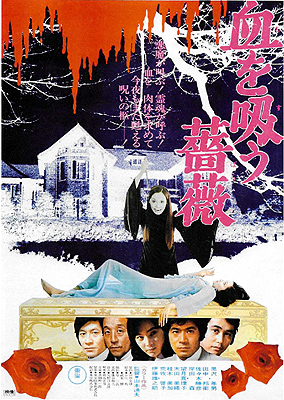
 Evil of Dracula / The Bloodthirsty Rose / Blood-Sucking Rose / Chi o Suu Bara (1974) ***
It’s hardly a burning question in horror fandom, or even in the narrower domain of Hammer horror fandom specifically, but it’s one that I ponder from time to time just the same: What if Lust for a Vampire didn’t suck balls? I don’t think it would have changed anything, you understand. Any historical impact that movie might ever have had, either on the fate of its studio or on the development of British horror cinema in the 1970’s, had already been made by The Vampire Lovers. It’s just that I would have liked to see a sexed-up riff on The Brides of Dracula’s “bloodsucker in a girls’ boarding school” premise that was worth the celluloid it was shot on. I was therefore delighted, albeit wholly unprepared, when Evil of Dracula, the last of three self-consciously Western-style fright films directed for Toho in the early 70’s by Michio Yamamoto, turned out to be exactly that.
The boarding school here is the Seimei School, in an out-of-the-way village far up north. (I’m not sure whether that’s supposed to mean Hokkaido, or just the uppermost reaches of Honshu, where Lake of Dracula was set.) Although the current term is well underway, the Seimei School is in need of a psychology teacher, and a Tokyoite by the name of Shiraki (Toshio Kurosawa, from Horror of the Wolf and The Water Margin) has come to take up the position. You’d think he was enquiring about the next bus to Castle Dracula the way the attendant at the train station treats him, but Shiraki is rescued quickly enough by his future colleague, Mr. Yoshie the pervy French teacher (Katsuhiko Sasaki, of Godzilla vs. Megalon and Godzilla vs. King Ghidorah). En route to the school, Yoshie and Shiraki pass the crushed wreckage of a car, which the former explains as the work of a drunken trucker the day before yesterday. In fact, there’s a connection between the smashed vehicle and the Seimei School, because one of the passengers killed in the crash was the wife of the headmaster (Shin Kishida, of Demon Spies, returning from Lake of Dracula). Shiraki has a second grim surprise awaiting him on that front, too, for people in this northern backwater have unusual funerary customs. Not only do they bury their dead instead of cremating them, but they leave the bodies to lie in state for seven whole days first while praying for their resurrection! When Shiraki visits the headmaster to report for duty, he learns that the dead woman— before whose portrait on the parlor wall a single white rose has been left in offering— is still down in the cellar, boxed up in an ornate coffin.
Maybe that explains the dreams that trouble the teacher on his first night at the school, which he spends in a spare room in the headmaster’s house. Shiraki seems to awaken to the sound of mournful singing, which he follows through the maze of the mansion’s upper story. Eventually, he finds a beautiful girl in a transparent negligee (jazz singer Yasuko Agawa, who appeared in movies like The Last Days of Planet Earth and Terror of Mechagodzilla under the name Tomoe Mari) lurking in the dark as if waiting for him. The girl is bleeding from two small puncture wounds in her left breast, right above the nipple, and Shiraki is just in the process of asking if she needs help when he is jumped from behind by a fanged, white-clad woman (Mika Katsuragi, who played a vampire in Lake of Dracula as well) whom he recognizes from her picture as the headmaster’s wife. Shiraki isn’t really sure what happens next— but surely it’s nothing real, for there’s certainly no evidence of a clash with the undead when he awakens in his borrowed bed in the morning. Still, the teacher is sufficiently shaken to risk his employer’s ire by sneaking down to the cellar and opening the dead woman’s casket, just to see if she really does look like the vampire of his dreams. She does indeed. And were his attention not soon taken up completely by the scolding he gets when the headmaster catches him snooping, Shiraki might have noticed, too, that she’s still capable of awakening in response to being disturbed.
A day or two later, Shiraki discovers something that renders his dream even more disquieting. Tucked away in a place where it was plainly not meant to be found is the student file of a girl named Keiko Monomiya, whose photo is the spitting image of the bloody-breasted seductress conjured up by the teacher’s subconscious. School physician Dr. Shinomura (Kunie Tanaka, from Kwaidan and The Village of Eight Gravestones, who possesses one of Japanese cinema’s all-time great character actor faces) confirms that Keiko had been a student at the Seimei School, but vanished without explanation just five days ago. The doctor avers that that sort of thing happens once or twice every year; the way he figures it, big-city girls like Keiko find it hard to adapt to the slow pace of life up north, and it’s only to be expected that a few of them would run off in search of excitement and stimulation elsewhere. Perhaps so. But Keiko’s three closest friends among the students— Kyoko Hayashi (Keiko Arumaki, of Terrifying Girls’ High School: Animal Classmates), Yukiko Mitamura (Mio Ota), and Kumi Saijo (Mariko Mochizuki)— are all worried about her disappearance. Surely she wouldn’t just split without telling any of them where she was going?
That’s about when Kyoko has a vampire encounter of her own, except that hers is definitely no dream. Also, it isn’t the headmaster’s wife who attacks her, but the headmaster himself! The girl retains no memory of the incident, however, and so far as her teachers and classmates are concerned, she’s just fallen suddenly ill. Her symptoms are strange enough to be worrying, though, combining pallor, lethargy, and a general wasting away with a curious form of delirium that leaves her eerily calm even as she says things that don’t make any sense. Also, Kyoko has a pair of little punctures on her tit just like Keiko did in Shiraki’s dream. (If in fact that was a dream, which the teacher now finds himself seriously starting to doubt.) Remarking on that to Dr. Shinomura leads Shiraki into a conversation that neither man expected to have, as the doctor comes clean about several things he knows (or at least suspects) about their workplace.
First of all, Shinomura isn’t half as cavalier as he acts about the Seimei School’s history of disappearing students. It’s just that his suspicions in that direction sound crazy, and he doesn’t want to share them with anyone he can’t trust absolutely. Secondly, there’s another weird pattern at the school concerning the headmasters and their successors, although Shinomura is at a loss to explain what it means. Since the founding of the Seimei School 80 years ago, each principal has hired some teacher from far away, and groomed him for a short time to take over; the old headmaster then retires early, claiming some indisposition, and is never heard from again. What makes that mysterious, to Shinomura’s way of thinking, is what happened ten years ago, right before the current head got the job. He wasn’t his predecessor’s first choice, you see. Initially, the post was offered to a man called Shimazaki (Susugu Katayama), who promptly went mad, and has been confined to the Kitahara Sanitarium on the other side of the mountain from the village ever since. Shimazaki left behind a diary full of cryptic ravings about devils hiding in human form, and Shinomura believes that the previous principal revealed something so terrible while preparing the teacher to take over that his mind snapped from the strain of it. The current headmaster announced similar plans for Shiraki at their first meeting, so maybe he should be worried about more than mere unpreparedness as he weighs his decision whether to accept the promotion.
But the most important thing, and the strangest, that Dr. Shinomura tells Shiraki is a local legend concerning an ancient, unburied coffin in the village cemetery. Centuries ago, when Japan was a hermit kingdom and outside cultural influences were strictly banned, a Christian sailor from an unknown Western land (played in the ensuing flashback by the otherwise unheard-of Robert Breen) washed ashore not far from where the Seimei School now stands. He fell into the hands of the authorities, who tortured him until he renounced his faith, and then turned him loose to die in the desert. (Japan doesn’t have any of those, so far as I can tell. It looks to me like Yamamoto shot these scenes on a beach with high dunes, carefully pointing the camera in every direction except toward the ocean.) The outcast outlander took to drinking his own blood to slake his thirst, then traded up to other people’s at the first settlement he came to. His first victim, a teenaged girl (Cabaret Diary’s Midori Takei) whose corpse he carried out into the desert with him, was resurrected by the power of the devil that possessed him when he abandoned his god, and the two of them became partners in a reign of supernatural terror. Eventually they were caught and executed by the villagers, and buried together in a single immense coffin. That box wouldn’t stay buried, however, and when it worked its way back to the surface, it was empty. Even now, Shinomura can’t quite bring himself to state explicitly his reasons for telling Shiraki that particular tale, but he doesn’t really have to. After all, there’s strong precedent for physicians teaming up with psychologists to fight vampires.
For all that they each entail a slightly different tradeoff of strengths and weaknesses, Michio Yamamoto’s triptych of counterfeit Hammer films are remarkably consistent in overall effect. What makes Evil of Dracula special alongside its siblings is its flirtation with Continental European eroticism and its unusual interpretation of vampirism. I don’t want to oversell the former point. Toho wasn’t Nikkatsu, and Evil of Dracula will never be mistaken for a Roman Porno flick, but Yamamoto learned well the lesson that the Hammer Karnstein trilogy was teaching about the box-office appeal of pretty girls biting each other on the boobs. I really can’t overstate the inventiveness of this movie’s take on the undead, however. It has recognizable roots in several different Western vampire traditions, but the total package is something I’ve never seen before anywhere. I’m sure you’ve surmised already that the successive headmasters at the Seimei School are in some sense all the same undead fiend, and that they and their wives are also in some sense the same entities as the shipwrecked Christian apostate and his victim-consort, but I promise you’ll never see the true meaning of “in some sense” coming. The revelation is extraordinarily gruesome when it arrives, too, and although Yamamoto implies more than he shows, he implies the shit out of it.
Evil of Dracula also benefits from an exceptionally strong pairing of regular-Joe vampire hunters, and from a heroine who turns out to be a little more capable than she initially appears. To draw a Hammer comparison once again, the combination of Toshio Kurosawa’s Shiraki and Kunie Tanaka’s Shinomura suggests what might have happened had one of that studio’s modern-day Dracula pictures pitted the vampire count against a partnership between Andrew Keir and Michael Ripper. Meanwhile, Mariko Mochizuki’s Kumi has pronounced streak of Final Girl in her, even if 1974 is maybe just a tad early to be speaking of Final Girls. Kumi still ends up needing Shiraki to rescue her, but she makes the vampires work a lot harder to put her in that position than you’d expect on the basis of the films from which Yamamoto was principally cribbing here.
The downside to Evil of Dracula is that these vampires just aren’t as scary as the ones in Lake of Dracula, let alone the unclassifiable undead girl in The Vampire Doll. With more human personality on display, Shin Kishida makes for a less satisfactory wasei Christopher Lee than he had when the vampire was simply an inscrutable malign presence. The changes to his physical appearance aren’t doing him any favors, either. Most seriously, Yamamoto forewent this time around the gold contact lenses that had been the mark of undeath in the two previous films, and you’d be surprised how powerful a diminishing effect that has on the vampires’ air of inhumanity. The longer, shaggier, puffier hair that Kishida sports here is most unfortunate, too, in much the same way and for exactly the same reason as Frank Langella’s bulbous bouffant in Dracula. There is, however, one new trick in Evil of Dracula that reclaims some of the lost ground. The original Japanese title, variously translated as The Bloodthirsty Rose or Blood-Sucking Rose, is a reference to the funeral flowers placed at various points around the headmaster’s house in tribute to his wife. In their natural state, those roses are all white, the color of death and mourning in Japanese culture. But whenever the vampires feed, the roses’ petals turn red in magical sympathy with the victim’s drained blood. It’s a subtly eerie effect, in a film that would have benefited from a couple more of those.

Home Alphabetical Index Chronological Index Contact
