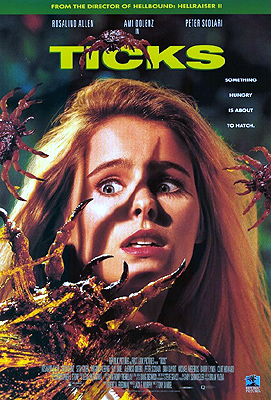
 Ticks / Infested (1993) ***
Nine months into my 27th year of writing about movies, there are a few types that increasingly leave me groping for anything new or even halfway interesting to say. Regrettably, one of the categories that most strain my critical creativity nowadays happens also to be one of my favorite things to watch: after all this time, what remains to be said about a humble, unremarkable, workmanlike monster flick? Ticks is a case in point. It’s solidly made, satisfactorily entertaining, and generally well worth an hour and a half of your time if you enjoy seeing people menaced by big (albeit mostly not giant) bugs. It’s hard to find anything unusual about it, however, beyond that there wasn’t much else like it being made in the early 1990’s.
Well, okay— I suppose the rather disorienting in media res opening is somewhat noteworthy. Teenaged Tyler Burns (Seth Green, from Arcade and Krampus) gets dropped off by his father (Masquerade’s Timothy Landfield) under an elevated freeway somewhere in Los Angeles. Dad says he’s doing it because he wants Tyler to get better. Okay…? No sooner has Mr. Burns driven off than Tyler draws the attention of a guy who calls himself “Panic” (Alfonso Riberio); basically, he’s the image of a young, black, big-city gangster that lived rent-free in the heads of white screenwriters throughout the 1990’s. Or at any rate, that’s how Panic comes across at first. Actually, he’s just fucking with Tyler, for like him, he’s waiting beneath that overpass to be picked up by a van bearing the logo of the Inner City-Wilderness Project. Oh! So that’s what this is about! Do-gooding child psychologists Charles Danson (Peter Scolari) and Holly Lambert (Rosalind Allen, from Sons of Darkness: To Die For II and Children of the Corn II: The Final Sacrifice) take troubled urban teens out into the woodlands to commune with nature and, or so they hope, to undergo some manner of psycho-social system reset. Charles and Holly already know Panic, too, so obviously this isn’t his first rodeo. Presumably his mama wants to make damn sure he doesn’t evolve for real into the person he fronts as. The other kids in the van have “problems” that seem similarly to be figments of their parents’ imaginations. Kelly Mishimoto (Dina Datrit) is intensely introverted. Dee-Dee Davenport (Ami Dolenz, from Children of the Night and Witchboard 2) is kind of a brat, and her boyfriend, Rome Hernadez (Ray Oriel, of Erotique and Cholo Zombies: Monstro), has maybe a bit of an attitude problem, but it’s clear enough that their folks sent them on this trip primarily because their relationship offends equal and opposite bodies of class prejudice. Tyler, though? His anxiety disorder is real enough. But since its roots lie in a time eight or ten years ago, when his dad got drunk on a father-son camping trip, and left him alone in the woods for some 48 hours, there’s a distinct note of fobbed-off parenting fuckups in his back-story, too.
Charles and Holly have committed a rather glaring fuckup of their own, despite being perceptive enough to bring along Danson’s adolescent daughter, Melissa (Virginia Keehne, of Invaders from Mars and The Dentist), to act as an intermediary between them and their charges. Camp Madeleine, the Inner City-Wilderness Project’s staging area, happens to be located very close to the secret compound where a pair of gross redneck brothers named Jerry (Michael Medeiros, from Alone in the Dark and RoboCop 2) and Jarvis (Clint Howard, of Carnosaur and The Wraith) grow marijuana on behalf of an unnamed creep (Barry Lynch, from Demonic Toys and The Whisperer in Darkness) who you just know is regarded in these parts as a pillar of the community— the chairman of the Chamber of Commerce, maybe, or the owner of the local John Deere and Lincoln-Mercury dealerships. Since roaming the woods is kind of the point of these trips, the proximity of Camp Madeleine to the pot farm makes it extremely likely that one or another of the kids will see something they shouldn’t.
And as if that weren’t hazard enough, the pot plantation is brewing up one hell of an unanticipated externality. You see, Jerry and Jarvis don’t grow just any old ditch-weed, despite their slovenly appearance. No, theirs is a sophisticated, scientific operation, with the latest and greatest in growing lamps, hydroponic tanks, and synthetic fertilizers. But because it’s still an illegal undertaking, there’s a marked DIY quality to all their equipment, and the brothers aren’t exactly botanical engineers. The plumbing carrying their high-tech fertilizer to the tanks leaks, and the chemical cocktail has some interesting effects when organisms other than Cannabis sativa are exposed to it. Take the common dog tick, for example. When some of the criminals’ growth-goop drips onto a tick egg sack, the arachnids that eventually hatch out of it emerge as big and as quick as a fiddler crab, and twice as ill-tempered as a yellowjacket. Furthermore, the mutant ticks are extraordinarily fecund, hatching at more or less full sexual maturity, and the anesthetic in their saliva that enables ordinary ticks to bite an animal without being noticed has become powerfully hallucinogenic. If they could figure out a way to harvest the stuff, Jerry, Jarvis, and their boss could expand their dope business in some exciting new directions! Alas, though, none of them realize what they’ve accidentally created until Jarvis finds himself doing life-or-death battle with a swarm of XXL ticks. Nor is the problem confined to the barns where the pushers grow their pot, for the whole surrounding forest is infested with the deadly bugs.
The kids at Camp Madeleine first encounter the ticks when Tyler finds one of their egg sacks inside a locker in the boys’ cabin, although neither he nor Panic nor Rome recognizes the gross, squishy thing for what it is before removing and destroying it. After all, there’s no end of gross, squishy stuff in the wilderness, right? That same principle leads Danson to dismiss the testimony of Tyler and Melissa later on, after the girl gets one of the newly hatched super-ticks on her during a stroll among the trees. It only stands to reason, doesn’t it, that a girl who hates the woods and a boy who fears them would exaggerate the size and aggressiveness of a bug that bit one of them? But even the smuggest, most self-impressed child psychologist has to admit that something is up once Panic’s dog, Brutus, inexplicably dies that night, feeble and insane despite having been perfectly healthy just hours before. Mind you, the local sheriff (Rance Howard— Clint’s dad— from Village of the Giants and Mars Attacks!) doesn’t see as it’s any of his business what animals get up to in the woods, but the vet (Judy Jean Berns, of Female Perversions) to whom Danson takes the carcass for examination regards the matter far more seriously. For one thing, nothing in that forest ought to be able to drain every drop of blood out of a dog, and for another, one of the ticks burrowed its way into Brutus’s innards in search of one last, meager meal. Dr. Kates knows a tick when she sees one, even if it is a crab-sized mutant, and she further understands that something truly fucked up must be happening in order for such a creature to exist.
Meanwhile, back at Camp Madeleine, trouble is breaking out all over, taking just about every form possible under the circumstances. Panic reasonably decides that he’s done with this bullshit, and that he’s going to back to Los Angeles regardless of what the vet has to say about Brutus. Rather less reasonably, however, he sets off for home on foot, through woods that he doesn’t yet realize are crawling with killer ticks. Dee-Dee and Rome go exploring in search of a place to bone where Holly won’t catch them, and wander right into the pot plantation/tick hatchery. And Melissa takes Kelly fishing in a marshy and well-hidden stream, where they end up catching the dead body of the sheriff, who evidently got too close for his own good to discovering who was really behind the local drug-trafficking ring. But none of that trouble is half as bad as what ensues when Jerry and his boss, while defending their compound from teenaged intruders, accidentally shoot a pressurized container holding one of their exotic fertilizers or pesticides. That stuff is flammable even when it isn’t under pressure, and the next thing you know, a forest fire is spreading in a crescent-shaped front from the pot plantation. Criminals and ticks alike flee from the fire, in the only viable direction: straight toward Camp Madeleine.
As I said before, I don’t have much to offer in the way of fresh insights regarding Ticks. It’s a routine film but an effective one, comparable overall to the 1988 remake of The Blob. Like that movie, Ticks applies what was then the state of the art in gore and gloppola to a genre formula decades old, and it succeeds in its limited aims mainly via the underappreciated power of just giving a fuck. The ticks themselves are very good— both the small puppets for the crab-sized “ordinary” mutants and the big animatronic contraption representing the truly gigantic tick that figures in the climax. Most impressively, all the bug puppets look like actual dog ticks, in ways that would seem to require their designers to spend some time studying electron micrographs before getting to work. That doesn’t sound like a high bar to clear, I realize, but it happens surprisingly rarely in movies that make monsters out of tiny animals that most people never look at closely. Meanwhile, on the human front, it’s already obvious that this Seth Green kid is going places, even if his quirky appearance is destined to make him more of a character actor than a leading man. And although Barry Lynch can’t compete with his more famous brother for sheer menace, he makes up for it by investing the outwardly respectable leader of the dope dealers with an unsettling foppish suavity that Richard could not possibly have pulled off. The forest fire in the third act creates a credible excuse for raising the pressure, turning what had been a diffuse “danger all around” situation into the functional equivalent of a siege on the main camp building. Finally, Ticks deserves credit for teasing a little complexity out of characters that initially look like a familiar array of teen-movie stereotypes, and for recognizing that “troubled” youth are often just youth whose idiosyncrasies inconvenience their parents. So while it’s neither a great film nor even an especially memorable one, Ticks is a film that gets the job done with aplomb. Sometimes that alone is worth celebrating.

Home Alphabetical Index Chronological Index Contact
