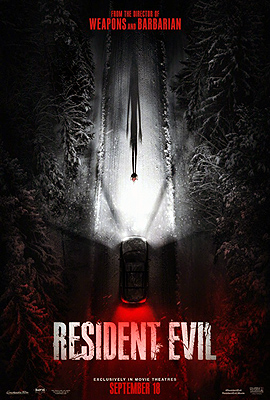
 Resident Evil (2026) ***½
Alright, now that’s more like it. Left to my own devices, I most likely would never have bothered to watch the current Resident Evil movie at all, considering what a turd the one from 2002 turned out to be. I have a friend, though, who is a devoted player of the video game series from which the films derive, and she did want to see it despite the franchise’s unpromising big-screen track record. I’m so glad I tagged along, because far from a trite and tedious action movie about a superhero supermodel spin-kicking CGI zombies, this Resident Evil is the next best thing to Clerks reinterpreted as a horror film. Its hero, if he can even be called that, is a well-meaning schmuck just trying to do his shitty job, who gets engulfed in the chaos when an outrageously irresponsible biomedical experiment breaks containment.
Bryan (Austin Abrams, of Tragedy Girls and Weapons) is a hospital courier, which basically makes him a Doordash driver for internal organs. He’s already having a pretty lousy night when we meet him, running an hour behind schedule on the last delivery of his shift due to steadily worsening weather, and being treated like a slow-witted child by everyone at the destination hospital when he tries to get a signature on the handover paperwork so that he can get paid. Also, his girlfriend, Michelle (Sara Paxton, from Shark Night and The Last House on the Left), just found out that she’s pregnant, and it’s obvious from Bryan’s half of the conversation as she breaks the news to him over his cell phone that nothing he could possibly say in response would be the right thing. So I reckon it’s about equal parts conflict-avoidance and economic panic that leads Bryan to jump at the chance when he’s offered a double-rate after-hours gig running some vitally important whatsit to Raccoon City General Hospital (I’m sorry, but I will never stop laughing at that “Raccoon City” bullshit) into the teeth of the intensifying blizzard.
Mind you, that’s going to require explaining to Michelle why he isn’t coming home like he was supposed to, which would be an unenviable task even if cell phone service along the country route to Raccoon City didn’t suck ass. While Bryan is distracted by his telecom woes, he fails to spot an old woman (Andrea Miltner, of Ripper 2: Letter from Within and Hellboy) walking straight into the road in front of him. He rams her so hard that she sails clean over the roof of his car, and lands in a heap some 30 yards behind where he finally skids to a stop. But by the time Bryan has collected himself sufficiently to deal with this new emergency, the victim has incredibly gotten up under her own power and vanished into the woods on the opposite side of the road. Following the woman’s footprints in the snow, Bryan eventually finds her, seemingly frozen stiff but somehow still alive. He gathers her up, carries her back to the car, and thanks his obviously defective lucky star that he was already on his way to a hospital.
Bryan hasn’t driven much farther, though, before he gets pulled over by a highway patrolman (Johnno Wilson) for swerving all over the road like a goddamned maniac (or like a fool with neither chains nor snow tires, driving to beat the clock in a goddamned blizzard). On the one hand, this is obviously real trouble— especially since practically the first words out of Bryan’s mouth are a confession to having run down the lady strapped into his passenger seat. But on the other, the cop’s intervention presents Bryan with a chance to hand the woman over to someone with both the training and the authority appropriate to her needs. Besides, the more time Bryan spends in the old dame’s company, the more her behavior freaks him out; clearly there was something seriously wrong with her even before she met the front bumper of his car. The cop grudgingly agrees to transfer her to his cruiser, but warns Bryan of dire consequences should he take that as an excuse to drive off on his own before they reach the hospital in Raccoon City.
Bryan upholds his end of the bargain just fine, but as the two vehicles emerge from the forest, the cop loses control of his SUV, and rolls it right off the road! Again Bryan tries to help, and again doing so makes his night considerably worse. When he reaches the overturned cruiser, the patrolman is dead, the woman is loose, and her intentions toward Bryan are visibly malign. A farcical circular chase around the cruiser ensues, ending only when Bryan steals a chance to grab the dead cop’s sidearm, and puts a nine-millimeter slug though the deranged granny’s heart.
You can see pretty well how this is escalating, and it will continue to do so every time Bryan pursues some seeming opportunity to end his mad adventure. Seeking help at a nearby farmhouse gets him chased by a Rottweiler with a head like something out of The Thing, and jumped inside the house itself by the old lady’s husband (Karel Dobrý, from Nosferatu and The Crow), who is in an even more advanced state of zombification. Bryan’s subsequent trek into Raccoon City on foot results in him being bitten hard enough to draw blood by a little girl who is transforming into a tentacle monster from the right foot up. The city itself is overrun by bizarre abominations that must have originated as its citizenry, and their population density rises steadily the closer Bryan gets to the hospital. Worst of all, it gradually becomes apparent that something got into Bryan’s system when the kid with the tentacles bit him, and that mere septicemia is really the best-case scenario.
The one good thing that happens to Bryan on the way to Raccoon City is that he gets at least a handful of actionable answers to the questions that have been accumulating since the old lady on the road got up and walked away from being flattened by his car. A bit outside the city limits, Bryan gets picked up by a woman named Maxine (Mercy’s Kali Reis) and a man named Paul (Paul Walter Hauser), who are both very interested in that cold satchel the courier has been doggedly carrying throughout this night of horrors. Those two both work for something called the Umbrella Corporation— Maxine in security, and Paul as a low-ranking executive— and it turns out that their firm is responsible for all the weird and terrifying shit going on in and around Raccoon City. A genetically engineered virus that evolves its hosts into strange new things, unpredictably and uncontrollably, got loose in an Umbrella lab, turned everyone in it into outlandish monsters, and is now spreading all over town as the mutated scientists and technicians run amok. Naturally that means Bryan himself can expect to become something out of a Wayne Barlow peyote trip sooner or later, but the good news is that the package he’s been carrying all this time contains the key to an antidote to the mutation plague. If he can just get that stuff into the hands of the right doctor at Raccoon City General, Bryan will be saving his own ass along with what’s left of the town, and perhaps even the whole human race.
It says a lot, I think, about what we’ve all been through during the 21st century so far that the Umbrella Corporation as imagined by writer/director Zach Creggar in this movie is so different from the one in Paul W.S. Anderson’s version from 24 years ago. The defining feature of Anderson’s Umbrella was evil: the firm’s secretive involvement in inherently immoral industries, its homicidally cavalier attitude toward its employees, and so forth. To be sure, the old Resident Evil’s plot was set in motion by a fuckup, too, but Anderson portrayed the fucking up as secondary to the underlying malfeasance. Cregger’s Umbrella is no less nefarious, but for him that’s less important than the fact that its leadership are a bunch of butter-fingered dumbasses. This Umbrella Corporation is what you’d expect to arise if Sam Altman had gone into biotech instead of making probabilistic word-guessing machines. Although the bottom-up view of the situation that we’re afforded leaves open the possibility of a wicked mastermind somewhere near the invisible top of the structure, Maxine is the only Umbrella employee we ever meet who isn’t a venal, inept coward who might just about be able to find their own ass with all the high-tech imaging equipment in the lab on the top floor of Raccoon City General Hospital. Resident Evil surprisingly and refreshingly depicts exactly the caliber of villains that beset us in the real world, bumbling, complacent child-men dwarfed by the scale of the catastrophe set in motion by their thoughtlessly self-serving actions.
Mind you, Bryan is hardly an impressive figure either, but that makes him a paradoxically appealing protagonist for a story like this one. Physically unremarkable, possessing no unusual skills, not especially bright, and certainly not brave in any normal sense of the word, the only thing Bryan has going for him is a decency-driven desire to do better, reinforced by a lack of options. Resident Evil puts this thoroughly mediocre fellow in a situation where forging ahead in spite of everything becomes the path of least resistance, because he sure as fuck doesn’t have the courage to stand and face what’s coming up behind him. I’ve been told by several friends who play survival-horror video games that that’s a pretty accurate reflection of the genre, so it seems plausible to imagine gamers finding this Resident Evil more satisfactory than its predecessors for that reason alone.
Another thing that I expect gamers will like about Resident Evil is how it mirrors with surprising fidelity the subdivision of modern video games into discrete sections based on the geography of the playing environment. Other movies adapted from video games have attempted that, but Resident Evil is the first I’ve seen in which the results feel organic to the narrative, and not merely a cheesy gimmick. After all, Bryan must get from Point A to Point B along a route that would naturally take him through a succession of distinct zones, even without factoring in the occasional need to detour through Raccoon City’s underground utility tunnels to evade some particularly foul and fearsome monster. Creggar uses some other tricks, too, to duplicate the feel of the source game, although I’m not really qualified to say how successfully. For instance, he supposedly favors camera angles that match some of the games’ favorite points of view, and he dresses many of the sets with objects recognizable as canonical bonus and power-up items, even if Bryan doesn’t often engage with them.
From my non-gamer perspective, however, the most striking and surprising aspect of Resident Evil is its sense of humor. It would be going too far to call this movie a horror-comedy, but it is suffused throughout with a pitch-black absurdity that both balances and intensifies its frequently quite effective shocks and scares. Many of the monsters have a comic or even tragicomic quality that makes their relentlessness and lethality all the more disturbing— and crucially, Bryan is allowed to acknowledge the preposterousness of his foes even as he panics in the face of them. The creatures that hurl themselves at him kamikaze-style from the roofs of the buildings on either side of the street leading to the hospital, for example, are nearly laugh-out-loud funny as they explode all around him into geysers of contaminated blood and offal, but at the same time, getting pancaked by one of them would obviously be a lousy way to die. Tonally, Resident Evil lands almost exactly equidistant between The Evil Dead and Evil Dead II, and Creggar is to be commended for keeping his balance on that very precarious perch throughout.

Home Alphabetical Index Chronological Index Contact
