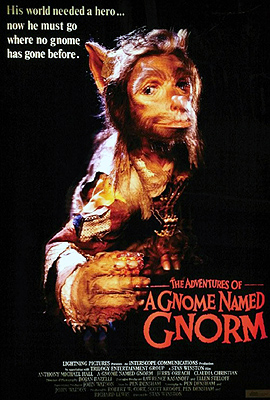
 A Gnome Named Gnorm / The Adventures of a Gnome Named Gnorm/ Upworld (1990) -**½
On one of the internet message boards that I still frequent because I’m 1120 years old, there used to be a guy who called himself Billy. I never met Billy in person, and we were never exactly friends, but it saddened me just the same when he died a few years ago, and I feel privileged to have known him even as remotely as I did. That’s because he was one of the few true cranks I’ve ever encountered, driven by strange obsessions that he was unable to explain, for they seemed so natural and reasonable to him that surely no explanation was necessary. Let me clarify, too, lest anyone leap to the wrong conclusion, that Billy was never a crank of the “lizard-Jews from the center of the Earth are putting Sharia law into chemtrails to turn our guns gay” persuasion. Rather, he was the kind of crank who’d post long, baffling dissections of 1980’s television commercials, analyzing them frame by frame as if they were the Zapruder film or a purported videotape of Bigfoot building a nest. He was the kind of crank who’d pore through miles of microfilmed newspapers and magazines at his public library, searching for advertising traces of Him, the long-lost porno about the life and loves of Jesus Christ, meticulously reporting everything he didn’t find. (To be fair, Billy did eventually turn up a handful of fascinating clues on that hunt— enough at least to settle in my mind the long-running controversy over whether Him ever actually existed in the first place.) He was the kind of crank who peppered his posts with mysterious catchphrases which he claimed were secret code words of Freemasonry. And who knows? Maybe they were.
But what brings Billy to mind right now is a term that he introduced to my vocabulary, which I hadn’t previously realized I needed: Twisted Kidder. A Twisted Kidder in Billy’s parlance was a movie or TV show aimed at a juvenile or family audience that turned out disturbing and strange by mistake. To pin it down a little more firmly, The Nightmare Before Christmas isn’t a Twisted Kidder, because it was consciously and deliberately aimed at an audience of morbid weirdoes; Carnival Magic is, because the whole film is suffused with an ineffable seediness that makes it feel like something unspeakable is constantly on the verge of happening. A Gnome Named Gnorm is a Twisted Kidder, too. It owes that status partly to an ugly-cute creature design that went horribly awry, partly to said creature’s totally forthright and oft-expressed appreciation for big tits and tight asses, and partly to a disorienting mismatch between technical virtuosity and sheer conceptual misbegottenness. A Gnome Named Gnorm, you see, is both the final feature film directed by monster-suit arch-wizard Stan Winston and a buddy-cop action comedy on the 48 Hours model, in which the titular gnome plays the Eddie Murphy role.
Casey Gallagher (Anthony Michael Hall, from Friend Request and Halloween Kills) is a rookie cop in Los Angeles who seems to imagine himself as one of the supporting characters in a mid-period Police Academy sequel. Most of his fellows on the force— especially a detective named Kaminsky (Jurassic Park III’s Mark Harelik)— rightly think he’s a putz, but a young, female detective called Sam (Claudia Christian, of The Garden and Arena) finds him strangely charming, and Captain Stan Walton (Jerry Orbach, from Universal Soldier and The Sentinel) has taken a nearly paternal interest in Casey for some unfathomable reason. Be that as it may, Gallagher’s qualifications for the assignment currently before him are impeccable: it’s an undercover gig, and Casey is the last person on Earth whom anyone would suspect of being a police officer. There’s a mobster, you see, by the name of Zadar (Eli Danker, of The Mummy Lives), and Walton has finally maneuvered him into a trap involving a sale of ostensibly stolen diamonds. Gallagher is supposed to meet him late at night at the playground on the campus of a defunct zoo, hand over the “hot” gems, and call down a horde of arresting officers upon him.
The sting goes weirdly awry, however. Either somebody has tipped Zadar off to what Walton is planning, or Gallagher is even less credible as a diamond-smuggler than he is as a policeman, because the man who meets him at the playground is merely an underling, and he cold-cocks Casey before the hapless rookie has done more than to initiate conversation. Then someone else whose face we don’t get to see blows Zadar’s lackey to smithereens with a goddamned bomb and drives off, leaving both Casey’s bait diamonds and the dead gangster’s briefcase full of cash hidden underneath a piece of playground equipment. Gallagher, upon regaining consciousness, gets pulled off the case the moment he finishes explaining to Walton what little he can of what went wrong. But although Casey goes home under a stinking cloud of disgrace, he does pull off one actual bit of detection before leaving the zoo. Somebody dropped the biggest fucking diamond any cop ever saw on the ground not far from the scene of the stakeout, and while Gallagher is in no position to say who that might have been, the stone sure as hell isn’t one of those that he brought to entice Zadar. Also, it’s clear that some faction of bad guys is taking Casey seriously despite his career-endangering fuckup, because he’s trailed back to his apartment by a bruiser with the world’s most astonishing jawline (Robert Z’Dar, from Post Mortem and Grotesque).
But while Gallagher was too unconscious to identify the man who blew up Zadar’s errand boy, somebody did in fact see the assassination go down. It happens that a gnome gnamed Gnorm (it bothers me somehow that the producers stopped one word short of committing fully to the bit) was on the playground at the time on an urgent mission for his normally subterranean people. Gnomish agriculture depends on a magically radiant gem called the Lumen, which needs to be recharged every ten years by exposing it to the rays of the rising sun. Ordinarily that duty falls to a member of the warrior caste, because the Upworld is a dangerous place when you’re only a foot and a half tall. But because Gnorm is in love with a female of his kind who bestows her affections only on heroes, he volunteered to undertake the quest despite his commoner status. He had just finished digging his way to the surface when Gallagher’s botched sting reached its explosive conclusion, and roaring fireballs are not something one typically meets with in the Underground. Gnorm panicked, and in his panic he dropped the Lumen where Casey could find it. Yup. It was that big, weird diamond. Obviously Gnorm couldn’t leave the Lumen in the hands of an Upworlder, so he stowed away in Gallagher’s back seat as the cop left the scene of his humiliation.
Thus does Casey’s already disorienting night become even stranger, for he spends the remainder of it grappling, caging, and attempting to communicate with the diminutive intruder. Trust is not exactly in ample supply between them, but Gnorm eventually brings Casey more or less up to speed on who and what he is, and what he was doing sneaking into Gallagher’s apartment. And as the gnome relates his version of events at the zoo, it dawns on Casey that he’s talking to a witness who could potentially identify the second gangster. How the fuck is he supposed to convince his fellow cops to accept a gnome’s testimony, though— especially now that he’s off the case in favor of Kaminsky? Actually, even worrying about that is probably premature at the moment, because Gnorm doesn’t care about any of this Upworld bullshit. All he wants is the Lumen, and he’s more than resourceful enough to get it away from Gallagher.
So basically Casey now has three problems before him. First, obviously, he has to locate Gnorm before the gnome finds his way back underground. That’s going to be easier than it sounds, because the unfamiliar perils of the Upworld significantly impede Gnorm’s progress homeward, and because anyone who sees a tiny guy with a caniform head wandering around Los Angeles is apt to recall the encounter. Then Gallagher has to convince someone else on the force (Sam seems like the best bet) that Gnorm can ID the bomber who spoiled the sting at the zoo. And although Casey won’t realize this for a while yet, he’ll also have to steer clear of the guy with the giant jaw, who has orders to kill him if it looks like he hasn’t gotten himself permanently benched. Meanwhile, there are two complicating factors lurking in the background, one for each of the co-protagonists. On Gnorm’s side, remember that Zadar is a dealer in stolen diamonds. What’s going to happen if he or one of his minions lays eyes on the Lumen? And on Gallagher’s side, notice that the most parsimonious explanation for what happened on the playground is to assume that either Zadar, his mysterious rival, or both have agents within the LAPD. In that case, winning his way back from disgrace will be doubly hazardous to Casey’s health.
I have no idea what could possess anyone to make a buddy-cop movie about a loose-cannon rookie and an uncooperative gnome. Granted, it’s normal enough for past-their-prime genres to spawn bizarre mutations during their senescence, but surely even a moment’s reflection should have sufficed to convince a producer, director, or screenwriter with any command of their senses that A Gnome Named Gnorm was a film for nobody. Kids who wanted gnome movies circa 1990 would have been looking for something on the continuum from Willow to Labyrinth to Troll. To give them diamond smugglers and police corruption instead was just asking for hurled popcorn buckets and rude messages carved into seat-backs with pocket knives. And I promise you, conversely, that no one ever emerged from a screening of Lethal Weapon or Beverly Hills Cop wishing that Mel Gibson or Eddie Murphy had been an animatronic fairy. About the one aspect of this movie that seems correctly calibrated to the tastes of an audience segment that exists on Earth is the strange and disturbing randiness that takes hold after Gnorm finds his way to the beach, or whenever he and Casey compare notes on their respective romantic woes. That stuff is very much of a piece with the strange and disturbing randiness of genuine tween boys— but even there, it’s surprising to see such direct acknowledgement of a phenomenon that Hollywood has mostly preferred to ignore for the sake of keeping the peace with parents who don’t want to think about it, either.
All that said, I do think I understand why this project, once greenlit, would appeal to Stan Winston specifically. If you approach A Gnome Named Gnorm strictly as a technical challenge for artists and artisans of special effects, it looks tailor-made for somebody like Winston. But that more than anything cements this movie’s status as a Twisted Kidder, because Winston and his creature shop rose to the occasion in so unsettlingly masterful a way. You want to know how lifelike the main puppet used for closeups on Gnorm’s face is? It has an articulated tongue! When you consider what the creature actually looks like, though (imagine a human face distorted to the proportions of a rat terrier’s), that degree of technical perfection places Gnorm in the most deeply shadowed nadir of the Uncanny Valley. He’s supposed to be grotesquely cute, like Gizmo from Gremlins or Hoggle from Labyrinth, but instead he’s as viscerally repellant as any forthright monster in Winston’s repertoire. Gnorm wouldn’t look a bit out of place bursting into David’s living room with a submachine gun in An American Werewolf in London’s Nazi-ghoul nightmare sequence.
Mind you, it’s interesting in itself that Gnorm is so horrifying. It demonstrates that Winston was thinking about more than just the little figurines in red hats populating the nation’s suburban lawns and gardens— which are, after all, a rather late addition to the folklore of gnomes. I already had to scrap one whole draft of this review for getting too thoroughly lost in these weeds, but briefly: gnomes in their original conception overlap so extensively with other Germanic fae beings like kobolds and svartalfar that it’s frankly misleading to try drawing sharp distinctions between them. The name comes from the writings of Paracelsus, a Swiss doctor and alchemist of the 16th century, who posited the gnomus as the elemental being of earth. (Sylphs, undines, and salamanders were the Paracelsan elementals of air, water, and fire, respectively.) His understanding of the gnome’s nature was heavily influenced by German miners’ tales of Bergermännlein, the “little men of the mountains”— creatures to which the miners attributed all manner of on-the-job mishaps in exactly the same way as World War II aviators blamed their mechanical troubles on gremlins. But whereas gremlins were always understood as a metaphor for the orneriness of delicate machinery, belief in Bergermännlein was earnest enough that Paracelsus’s contemporary, Georgius Agricola, included them in his treatise on living things under the ground, De Animantibus Subterraneis. And of course the little men of the mountains, in their turn, grew out of pre-Christian stories about elves, dwarves, dark elves, and so on (none of which are altogether distinct, either). The point is that Gnorm owes far more to all those very old tales about strange, capricious, and often inimical little creatures working magic at the bottoms of mines than he does to any contemporary pop-culture understanding of gnomes. Seeing such a treatment in a movie like A Gnome Named Gnorm is disorienting in much the same way as the Aristophanean portrayal of the title character in Hercules in New York.

Home Alphabetical Index Chronological Index Contact
