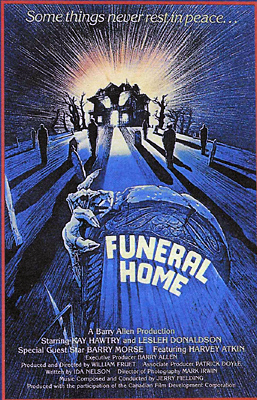
 Funeral Home / Cries in the Night (1980/1982) *½
If you’ve been reading this site for a while, then you’ve probably heard this refrain before: Canadian slashers don’t play by the rules. Normally I mean that in a positive sense. In a genre as slavishly devoted to its conventions as the slasher movie, the surest route to memorability is to thumb your nose at as many of those as you can while still remaining within the genre’s ambit. And in that spirit, Canadian filmmakers have given us slashers without Final Girls, slashers in which the most obvious Final Girl candidate is also the most plausible suspect, slashers in which the killer is a centuries-old rape demon, and so on. But sometimes disregarding the rules accomplishes nothing but to demonstrate why they became rules in the first place. In the case of the slasher film, the advantage of sticking to the formula is that there has never been an easier way to make a minimally watchable (or adequately profitable) horror flick. The stock slasher template gave the least imaginative bozos on Earth a way to make money making movies that were at least tolerable— and occasionally somewhat enjoyable— to sit through. Even Sean Cunningham could do it! And William Fruet’s Funeral Home shows what can go wrong when somebody roughly on par with Cunningham attempts to wing their way through a slasher without giving the recipe more than a cursory glance. On paper, it ought to be another interesting rule-breaker in the distinctive Canadian style, leaning as it does on a combination of 1960’s psycho-horror and 1860’s gothic mystery tropes in preference to Suburban Splatter or Spam in a Cabin. In reality, though, it’s listless, dull, and predictable. This is one off-model slasher that might have benefited from having a practical-joking boob, a skinny-dipping hot chick, a dumb jock with a nice butt, and a stabbing every twelve minutes on the dot.
Heather (Lesleh Donaldson, from Happy Birthday to Me and Deadly Eyes) is on a mission. Her grandmother, Maude Chalmers (Canuck TV longtimer Kay Hawtrey, whose movie work oddly consists for the most part of bits in the likes of The Clown Murders and Videodrome) has finally decided that her mysteriously vanished husband, James (played in flashbacks by Jack Van Evera, of Stone Cold Dead and The Incubus), isn’t coming back, and has set about turning their great, big house on the outskirts of Northampton into a “tourist home.” I’m guessing that’s what they call a bed and breakfast in the Great White North. It’s a lot of work for an old lady on her own, so Heather has volunteered to spend the summer helping Maude get the place up and running. But as the girl learns while hitching the last leg of the ride from helpful, horny van dude Rick Yates (Dean Garbett), there’s also a special handicap confronting Grandma’s new business venture. James Chalmers was an undertaker before he went MIA, and a lot of tourists are apt to feel skittish about vacationing in a converted funeral home. Nor is there much chance of Maude keeping the building’s history from finding its way to the ears of prospective customers, because the family is known in town as “Chalmers the Embalmers.”
The first hint of real trouble, though, is for our ears alone. Down in the basement, where the workshop that gave James his nickname still stands idle— and where Heather and Billy the halfwit handyman (Stephen E. Miller, of The Stepfather and Runaway) are forbidden to go— Maude can be heard on the night after Heather’s arrival arguing with her supposedly absent husband over the girl. Evidently James dislikes kids, and considers Heather a nuisance in the making. He doesn’t sound convinced, either, by Maude’s pleading that Heather isn’t a child anymore, and can be trusted to behave responsibly. Not a conversation that bodes well for anyone, for any number of reasons. Also, one has to ask whether the old dame is really cut out for the hospitality industry, even without an unseen cellar husband to complicate matters. Extremely religious and conservative to the point of prudery, how is she going to bear opening her home to the likes of Harry Browning (Harvey Atkin, from Visiting Hours and The Last Chase), who arrives for a weekend away from the old ball and chain with his brassy, rude mistress, Florie (Peggy Mahon), in tow?
Then there’s the Porsche in the haystack. A few weeks back, a city slicker came to Northampton sniffing after land for some development deal. He seemed particularly interested in the Chalmers place, but Maude sent him packing. When the locals stopped seeing him, it was natural to assume that he’d just moved on in search of other country folk to pester for their property. But a bright red Porsche 924 attracts a lot of attention in a community like this, so when a farmer (Les Rubie, from Blue Monkey and Spasms) finds one hidden inside his pile of hay once the cattle have eaten their way into it a bit, he recalls exactly where he saw that vehicle before. The constable who responds to the summons is Joe Yates (Alf Humphries, of My Bloody Valentine and Bedroom Eyes), Rick’s dorky brother. A rookie on the police force, Joe figures this is his chance to make a name for himself, but he doesn’t know his boss very well. The sheriff (Robert Warner, from Octaman and Deranged) is the kind of small-town lawman who considers the problems of outsiders to be definitionally not his, and he all but orders Yates not to pursue the matter. Joe knows he’s on the trail of something big, though, so he keeps digging anyway— especially after he learns that the would-be land magnate wasn’t the only stranger whom people just sort of stopped seeing during the past couple years, even though nobody can say where they went.
Joe Yates won’t be the only one investigating, either. First of all, Heather learns more about her grandparents than she’s ready to accept when Rick tells her both about a terrifying childhood encounter with Chalmers the Embalmer, and what the townspeople universally regard as the true story behind his “disappearance.” To hear Rick tell it, James Chalmers was a violent drunk and a barely-controlled psycho, and he didn’t so much disappear as run off with some woman from out of town. And by a curious coincidence that is really nothing of the sort, Maude’s favorite among her first crop of guests— a quiet, older fellow called Davis (Barry Morse, from Murder by Phone and Asylum)— isn’t really on vacation as he claims. He’s on the trail of his missing wife, Helena, whom he’s traced not merely to Northampton, but to James Chalmers specifically. The sheriff has been as dismissive of Davis as he was of the land-shopper with the 924, but the villagers have had plenty to say.
That’s about when Harry and Florie go missing. Or, from the audience’s more informed point of view, when somebody driving the Chalmers pickup truck forces their car off one of the cliffs overlooking the flooded quarry that does double duty in these parts as community swimming hole by day and lovers’ lane by night. Note that this happens about 24 hours after Maude catches on to what the couple are really doing at her house, and twelve or so after they flatly refuse her orders to pack their shit and leave. It also happens about twelve hours after Florie makes a big production of humiliating Billy with a mocking pseudo-seduction. One of Rick’s friends finds Florie’s body while swimming a day or two later, at which point Constable Yates springs into action. Dragging the quarry turns up Harry Browning, too, together with the ruin of his car, after which not even that dipshit sheriff can plausibly continue to blow off all the vanishing outsiders as drifters who wanted to disappear. Then, when Mr. Davis finally feels like he’s learned enough to confront Maude directly about James and Helena, somebody kills him as well, and buries him in the backyard of the Chalmers house.
The suspicious deaths of two recent customers and the sudden, unexplained absence of yet a third combine to leave Heather more receptive than she had been to thinking ill of her grandparents, and she starts noticing patterns that had eluded her before. Like it hits her at last that Maude is always talking about James’s judgments and opinions as if they still counted for something, and indeed as if he were still in a position to enforce them. She starts thinking about the zeal with which the old lady guards the spaces in the house that were associated with her husband’s work— the cellar especially, but also the garage where James’s prized mid-50’s Cadillac hearse reposes in a state of preservation worthy of some grease-monkey Miss Havisham. Most of all, Heather notices how much time Grandma herself spends down in the forbidden basement at night, and how hers isn’t the only voice that drifts indistinctly upward through the ventilator ducts while she’s there.
The fundamental problem with Funeral Home is that it’s too obvious to work as a mystery, and too demure to work as horror. It takes very little effort to catch on, very early in the proceedings, that Maude Chalmers is a gender-flipped Norman Bates, unwholesomely devoted to the memory of a cruel and domineering husband instead of a cruel and domineering mother. Nor does it take much more to realize what Heather is ultimately going to find in the basement. Embalming, after all, is conceptually adjacent to taxidermy, and the old gal even shares Norman’s profession! Meanwhile, Mr. Davis is a bluntly direct analogue for Psycho’s bank detective, Arbogast, and he gets taken out at roughly the same point in the narrative, with broadly comparable results. A movie simply can’t flaunt its influences this openly and still expect to surprise anybody, especially when foremost among those influences is something that everyone watching is virtually guaranteed to have seen. It’s frustrating, too, because Heather’s role in Funeral Home exposes Psycho’s craftily concealed debt to the gothic tradition, with Ma Bates as a novel spin on the Attic Baby, and the house on the hill as a vestigial Castle of Otranto. A cagier treatment of this same story could have offered many of the same virtues as Silent Night, Bloody Night.
Since most veteran horror fans will have spotted all the twists coming from the moment Rick first mentions James Chalmers’s rumored affair with Helena Davis (and the real sharpies will know what’s what by the end of that initial overheard conversation between Maude and “James”), it becomes all the more vital that Funeral Home put its back into the scares to compensate. Alas, it does no such thing. The gore is feeble, the suspense nonexistent, and audience investment in the characters’ fates effectively nil except during the final showdown between Heather and her mad grandma’s alternate personality. This is also one of those films that mistake the mere existence of a black cat for a horror set-piece, and anyone who’s ever lived with a cat will observe at once that the animal’s dubbed-in vocalizations never remotely match its onscreen behavior. The most ludicrous example is the scene in which the audio yowls furiously while the video merely paws at the window to be let in. The only moment of actual frisson that Funeral Home manages to generate in the whole 84 minutes preceding the climax comes when the girl at the quarry finds Florie’s waterlogged corpse.
I would be remiss, however, not to extend some damningly faint praise to Funeral Home’s finale (which is put together like a Final Girl sequence, but doesn’t quite qualify as one without a proper body count leading up to it). Kay Hawtrey is no Betsy Palmer, and Lesleh Donaldson is no Adrienne King, but their death-struggle has just a bit of heft to it thanks to the two actresses’ believably affectionate chemistry as grandmother and granddaughter throughout the film. One catches some glimpses of how good it could have been, too, whenever Maude fleetingly asserts herself to plead with “James” on Heather’s behalf. I don’t think I’ve ever seen a multiple-personality killer handled that way before, and it’s interesting to watch even if Hawtrey lacks the chops to do the concept justice.

Home Alphabetical Index Chronological Index Contact
