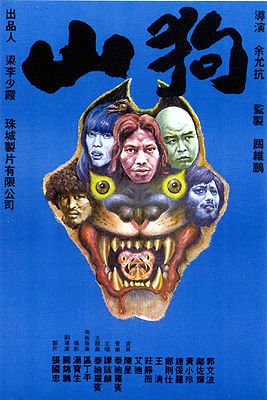
 The Beasts / San Gau / Shan Gou (1980) ***
There’s a certain amount of geographic ambiguity in play whenever one talks about Hong Kong. The name refers equally to the coastal city where the British made their first colonial inroads into China, to the island on which that city stands, and to the whole former British protectorate focused on it, including several nearby islands and most of the Kowloon Peninsula as well. Hong Kong, that is to say, isn’t a city-state like Singapore, even if the city of Hong Kong is the first thing that springs to mind. I point that out because it helps to explain the initially surprising existence of backwoods horror as a small but recognizable subgenre in Hong Kong cinema. After all, you can’t very well have backwoods horror unless you have backwoods! The Beasts is one such film. It operates mainly as a Cantonese counterpart to The Last House on the Left, but it flips the regional and class valences by having its doomed suburban teenagers come to grief on a camping trip rather than an excursion to the big, bad city.
The teens in question are Chen Ah-Ling (Patricia Chong Jing-Yee) and her older brother, Ah-Wah (Eddie Chen, of Devil Fetus and Mini-Skirt Gang), the children of Chen Xing (Chan Sing, from The Wandering Swordsman and Vengeance!), a carpenter who lives and works somewhere in the suburbs of Kowloon City. This weekend, the Chen siblings are going on a camping trip to the mountains overlooking the village of Kau Shan Wah in company with three of Ah-Wah’s friends from school: Ken (Ko Cheun-Man, of Rigor Mortis), Louis (Paul Chung Biu-Law), and Ken’s girlfriend, Pauline (Wong Siu-Ling, from Dragon Strikes). Truth be told, Ah-Wah is the only one of the kids who fully appreciates what they’re getting themselves into here. Forget about the mountains for the moment— even Kau Shan Wah itself is so remote that there’s no regular train or bus service there! Reaching the village requires taking a bus to the end of the line, and then transferring onto a rickety cargo truck that shuttles goods and people alike into and out of Kau Shan Wah every few days. There’d be real trouble if anything were to go wrong over the weekend. None of the campers have their minds on any such possibilities, however. Ah-Wah is thinking only of burnishing his already considerable bona fides as high school he-man. Ah-Ling, coddled kid sister that she is, is focused on the thrill of getting to do something grown-up and adventurous for once. Ken and Pauline have their heads exactly where most teen couples would when faced with the prospect of a weekend together totally free from adult supervision. And any thoughts whatsoever that Louis might have formed before setting out fade into insignificance upon meeting his classmate’s lovely sister.
It happens, too, that the mountains harbor a hazard that not even Ah-Wah has considered. Among the residents of Kau Shan Wah are a quintet of young drifters, all of them related to one degree or another. They’ve settled there for the moment because the village and its environs offer an opportunity to run absolutely feral while still remaining within reach of the more conventionally exciting Kowloon City. Their leader is a well-traveled career criminal known by the incongruous nickname, Dutchman (Wong Ching, from Shaolin Temple and Spiritual Kung Fu), because he’s always recounting tall tales of his exploits in Amsterdam. (Even at the turn of the 80’s, that city had an international reputation as a paradise of permissiveness.) Dutchman’s brother, Snake (Kwan Kam-Ming), is aptly named, for not only does he keep as many of the venomous reptiles as his semi-nomadic lifestyle permits, but his looks and temperament alike recall such nastier members of the ophidian family as the mamba or the spitting cobra. Ko (Kwong Joh-Fai, of Human Pork Buns: The Untold Story) and Fu (Kwok Man-Bo) were born to be toadies to some charismatic bastard. With better connections or more education, they might have become Triad enforcers or foot soldiers for some wannabe demagogue, but they fell in with Dutchman instead. And Mo (Kent Chang Jak-Si, from He Lives by Night and Vampire’s Breakfast) is Dutchman’s idiot cousin. On his own, he’d be mostly harmless, but he’s the kind of dummy who’ll do whatever he’s told by anyone whom he perceives as smarter than himself— and Dutchman is nothing if not an idea man.
It’s basically just dumb luck that brings the teenaged campers to the attention of Dutchman and his gang. Ko and Fu stumble onto the tents not long after the kids have finished setting them up, and while Ah-Wah and Louis are away gathering firewood. Ken is conspicuously not brave, and the two creeps have almost psyched themselves up into having a little nonconsensual fun with Ah-Ling when the other two boys return. Ko and Fu wouldn’t like those odds even if Ah-Wah and Louis weren’t so obviously ready to fight them on Ah-Ling’s behalf, so they scamper off into the woods whence they came. They tell Dutchman about the campers, however, and he agrees that his followers’ discovery warrants further attention. The gang keep a close but stealthy watch on the campsite, and the next time Ah-Wah and the others split up (incredibly, it never occurs to any of them that they might not have seen the last of yesterday’s intruders), they spring into action. All five thugs descend on Ah-Ling while she washes the morning’s dishes alone at the foot of a waterfall, and take turns raping her until she pretty much shuts down. When her brother and would-be boyfriend return this time, and find the girl lying naked and catatonic on a stream-swept rock, their thoughts turn immediately to revenge. Two high school boys are no match for Dutchman and his cronies, though. Louis escapes from the ensuing confrontation with his life, but the gang hound Ah-Wah into one of the panji pits that they use to catch wild hogs, and that’s the end of him.
Rather to my surprise, the Proper Authorities put in an appearance at this point. Although the headman of Kau Shan Wah (Che Hung, from Seeding of a Ghost and The Spooky Bunch) sees no reason to assist outsiders in any way, Dutchman and the lads aren’t exactly popular among the common villagers. A farmer by the name of Bing (Sek Chung-Yuk, who appeared in several installments of the Something Incredible anthology series, including Blood Curse and My Death Project) has had trouble of his own with the hoodlums, and he fingers them as the likeliest suspects when Inspector Chu of the C.I.D. (Eric Yeung Jan-Yiu, of Guests in the House and The Imp) comes to town. It’s hard, though, to pin down five guys as well accustomed to living by their wits as Dutchman and the gang, especially in a place where cops aren’t liked much better than thieves, rapists, and killers, and when the only living eyewitness against them is obviously out of her mind. If Chan Xing wants justice for his two children, he’s going to have to find the hooligans and take it out of their mangy hides himself.
Although The Last House on the Left belongs broadly to the tradition of rape-revenge cinema, it also does several unusual things to segregate the films that follow its lead into their own subgenre within a subgenre. Most obviously and easiest to articulate, The Last House on the Left is a story of vicarious revenge, for the direct victims are both too dead to pursue their own retribution by the time Krug Stillo and his gang are finished with them. It therefore inherently relates to vengeance somewhat differently from the likes of I Spit on Your Grave or Ms. .45, in which the victim does her own avenging. Another crucial distinction that’s a bit harder to communicate might be thought of as pressurization. Mari and Phyllis are captives of the gang when they’re raped and murdered, while the gang themselves are effectively captives in turn when Mari’s parents pay them back in kind for their brutality. Given both the situations and the mix of personalities in play, there’s no credible possibility of the story’s tensions finding release in mere escape. Some explosion of lethal violence feels inevitable from jump, even without factoring in the metafictional expectation that explosions of lethal violence are exactly what the audience was promised and has come to see. And finally, there’s the matter of fate. In The Last House on the Left, it’s sheer happenstance that leads Stillo and his followers into the clutches of the people who, in all the world, would most like to see them dead, but it’s a happenstance that feels cosmically ordained. The universe has a black sense of humor, and the killers have just become the butt of the joke. What’s curious about The Last House on the Left’s copycats is that they remain recognizable as copycats even though few if any of them check all of those boxes. Indeed, a few manage to make their subgenre affinities clear despite using only one major element of the formula, and loading up on the minor ones instead.
The Beasts falls into the latter category. It resembles The Last House on the Left primarily in its overall plot structure (oddly not an important formula element in this sub-subgenre), in its characterization of Dutchman’s gang as a twisted sort of family, and in building its final act around a father’s revenge on behalf of his brutalized children. But it does something with Chen Xing’s campaign of vengeance that I wasn’t expecting at all, so that even its biggest lift from Wes Craven requires an asterisk. Once Chen goes on the warpath, The Beasts starts behaving less like a copy of The Last House on the Left than like a hybrid of I Spit on Your Grave and Death Wish. Indeed, The Beasts mixes those two templates together in ways that strikingly prefigure Death Wish II, which was still two years in the future when this movie was made. There’s no fate or coincidence enabling the parent’s revenge here. Chen hunts down the bastards who raped his daughter and murdered his son consciously, deliberately, and with a singleminded determination that’s more typically a hallmark of rape-revenge heroines. I can’t recall ever seeing that particular transformation before in a Last House clone, but it feels so natural when The Beasts does it that I now find myself wondering why it doesn’t happen more often.
It makes sense, though, that such an innovation would arise in Hong Kong. If anything, that kind of all-consuming vengeance quest is even more typical of kung fu movies than it is of rape-revenge pictures. Why not put a locally familiar blueprint to a new and unusual use? That echo of kung fu tropes makes it all the more curious, however, that there are no martial arts in play here— not even during the final showdown between Chen and Dutchman, despite Wong Ching’s considerable experience playing fu-film villains. Hand to hand, Xing Chen is a brawler at best, and he keeps his distance from his enemies when he can. His preferred method, rather, is to lure the criminals into deadly booby traps, much like the one they used on his son. That feels like it’s supposed to be a thematic element in some way, but if so, it never quite develops far enough for any clear meaning to emerge. Maybe I’m overthinking it, though. Maybe it’s just that a carpenter is good at making things, so of course that’s what Chen uses to give him an advantage. Regardless, it gives The Beasts an extra dash of personality when the rapists get theirs via snares, pits, and an attic full of venomous snakes instead of some conventional instrument of death like a knife or a pistol.
Home Alphabetical Index Chronological Index Contact
