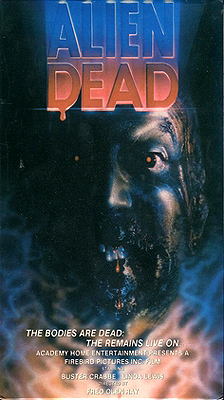
 The Alien Dead / It Fell from the Sky (1980) -*½
Fred Olen Ray told us all exactly who he was going to be as a filmmaker, right from the beginning— or as close to the beginning, anyway, as makes no difference. The Alien Dead wasn’t quite his first film, but it was the first one you had a chance to see if you didn’t find yourself in Florida in 1978. And everything that we now recognize as a hallmark of Ray’s work (unless, I suppose, you know him only from his latest self-reinvention as the guy who makes basic cable Christmas movies) is already present in it. The Alien Dead was made quickly and on the cheap, of course, under conditions that demanded a great deal of flexibility and improvisation. It has a forthright exploitation sensibility, with violence and gore aplenty, plus pretty girls of marginal acting ability gratuitously doffing their tops. And it’s pretty much utter crap, which is the quality that I suspect even the Christmas movie crowd will most strongly associate with the name, Fred Olen Ray. But The Alien Dead also exemplifies Ray’s more specific idiosyncrasies, like his off-kilter sense of humor, his reverence for the trashfilm luminaries of previous generations, and his affection for the pop culture of his parents’ day across all media. Most surprising of all, The Alien Dead shows Ray already alert to any and every opportunity to recruit washed-up stars into his movies in order to exploit whatever residual drawing power they might still command.
A gator poacher by the name of Griffith (Norman Riggins) has a counterintuitive idea for making his fortune. As he explains to his wife and partner in crime (Nancy Kranz), the sudden disappearance of alligators from a region of the swamp where they were abundant until just a few months ago is precisely the reason why they’re concentrating their activities tonight in that blighted locale. If the gators had simply gone somewhere else, their migration would have been noticed by the Griffiths and their fellow swamp folk. Something must have killed the reptiles en masse instead— pollution, disease, whatever— and since the commercial value of alligator skin lies in its virtual indestructibility, it’s a safe bet that all those carcasses are now basically bog mummies, their hides intact no matter how putrid the underlying flesh might be. It happens, however, that the gators weren’t exterminated by any mere environmental hazard. No, they fell prey to a predator even more formidable than themselves, and whatever it is, it puts a halt to Griffith’s scheme by dragging his wife beneath the murky water. The other poacher gets away having seen only enough of the attacker to know that it wasn’t any of the things that should normally be found in that swamp.
Griffith flees in hysterics to the office of Sheriff Kowalski (the old-timey chapterplays’ foremost action hero, Buster Crabbe, whom we’ll see in his prime whenever I get around to Planet Outlaws and Rocket Ship). Kowalski is in no mood to listen to fish stories from a career criminal, especially if that means interrupting the card game that he was winning against his deputies. Also, the sheriff is grumpy from being grilled on some matter of local politics by newspaper reporter Tom Corman (Ray Roberts), who at least had the consideration to make prior arrangements for intruding upon poker night. Corman, however, finds the poacher’s story far more interesting than Kowalski does, for it happens that the patch of swamp where Mrs. Griffith disappeared has been the site of quite a few strange goings on of late. There were the vanishing gators, of course, but before that, there was a houseboat full of rowdy out-of-towners mysteriously destroyed, leaving only a single survivor. For that matter, that was also where game warden Miller Haze (Biohazard’s Mike Bonavia) caught a record-breaking bass that weirdly retained juvenile markings despite its enormous size. Corman persuades Griffith to meet him in the morning, to show him the spot where he last saw his wife. Kowalski, meanwhile, puts out a bounty on the rogue alligator which he’s already decided must be the culprit.
The only thing out of the ordinary that Corman encounters on his first foray into the swamp is Shawn Michaels (Linda Lewis), 20-something daughter of notable local eccentric Emmett Michaels (George Kelsey). Knowing that Emmett loves to spin a yarn, Tom accompanies Shawn back to the Michaels cabin to fish for anecdotes that might be relevant to any of the recent peculiar happenings in the swamp. He gets several earfuls, but can’t see how they add up to anything. There’s something about a blue-on-blue dogfight in the aftermath of World War I between Michaels (who barely looks old enough to have fought in Korea) and his supposed Army Air Corps rival, Eddie Rickenbacker, which ended with Rickenbacker crashing into the swamp in a plane laden with experimental germ bombs. There’s something about ancient Seminole legends of a giant, predatory possum, which Emmett credits with eating all the alligators. And there’s also a running thread about the Griffiths’ haplessness as poachers, and about Mrs. Griffith’s penchant for infidelity. So pretty much a bust, so far as Corman’s principal reason for the visit is concerned. On the other hand, it does at least appear that Tom might be getting laid in the not-too-distant future, since Shawn is obviously attracted to him despite her constant warnings about what her daddy would do to him if he ever laid a hand on her.
Meanwhile, residents of Oviedo, the township nearest to the troublesome swamp, are getting killed in ones and twos by packs of amphibious, blood-drinking zombies. Some of the victims get theirs by venturing into the swamp, like the two rednecks hoping to claim Kowalski’s bounty (John Leirier and Rich Vogan), or the anonymous skinnydipping girl (Jocelyn Davies) who acts as The Alien Dead’s deployment system for the Cheapest Special Effect. But others, like the young intern at Corman’s paper (no idea) and the squabbling old couple (not sure about these two, either), are killed on the grounds of their own homes, which happen to stand just a little too close to the wilderness. Those attacks all go unwitnessed by anyone who lives to tell the tale, however, so Kowalski remains set on his rogue gator theory. Given the sheriff’s reaction when Tom and Shawn escape from a zombie attack soon after discovering Mrs. Griffith’s mangled and exsanguinated body, I’m not sure any corroborating testimony would help, anyway.
Tom and Shawn won’t be totally without allies, however. For one thing, catching that giant baby bass has left Miller Haze much readier than the sheriff to believe that something truly out of the ordinary is happening out in the swamp. And for another, Dr. Ellerbe (Martin Nicholas, from Angel Eyes and The Tomb), who performs the autopsy on Mrs. Griffith, recognizes at once that no local hazard he knows about should be able to inflict the kinds of damage that killed her. Furthermore, it happens that one of Ellerbe’s patients— a woman named Mae Hawkins (Ellen Contello)— was the sole survivor of that houseboat wreck people keep talking about. Although everyone who’s heard her story so far has dismissed it as a manifestation of the mental breakdown that she undeniably suffered in the aftermath, Mae’s version of events is both absolutely true and distinctly relevant to the current swamp zombie situation.
The Alien Dead strangely never feels like it was really supposed to be a zombie movie. Details like Miller Haze’s freakish bass and Emmett Michaels’s Seminole possum-monster seem intended to point toward some kind of giant, mutant animal, and it’s difficult to envision these swimming corpses depopulating a swamp of its alligators. Similarly, although the notion of a radioactive meteor crashing through the hull of a houseboat on its descent and reanimating the slain passengers is no more ridiculous than the notion of it turning some normally inoffensive marsh critter huge and predatory, the latter plainly has the greater weight of B-movie tradition behind it, contaminated Venus probes notwithstanding. There is indeed a reason for this. The Alien Dead started life as Swamp of the Blood Leeches, a script which Ray conceived as a loose remake of The Giant Leeches. But once he had the funding lined up, he realized that there wasn’t enough of it to cover leech puppets or costumes that would pass muster in 1980. Ray therefore reworked Swamp of the Blood Leeches to feature far more economical monsters— only he did so in something of a rush, without bothering to change those aspects of the script designed to foreshadow mutant leeches specifically. Perhaps substituting amphibious zombies for giant leeches would have seemed a less incongruous trade to Ray than it would to you and me, seeing as he made The Alien Dead just three years after his gig doing odd jobs on the set of Shock Waves.
That wrinkle to The Alien Dead’s origins explains more of the movie’s peculiarities than the mismatch between the nature of the monsters and the circumstances surrounding them, too. If you’ve seen The Giant Leeches, then you may recall that it was as much a hicksploitation melodrama as it was a monster flick. In much the same way, The Alien Dead often takes on the character of a Li’l Abner Sunday strip overrun by zombies. Admittedly, that’s just a very Fred Olen Ray thing to do, but since we’re very close to the beginning of Ray’s career here, it’s worth considering how this sort of conceptual mixing and matching might have entered his thinking in the first place. Looking closely at The Alien Dead, we can see nods not just to The Giant Leeches, but to a variety of Roger and Gene Corman productions from the Filmgroup era— and one of the most striking features of films like Beast from Haunted Cave and The Little Shop of Horrors was the elder Corman’s fearlessness in those days about throwing together elements of seemingly incompatible genres in the hope of appealing to multiple audience segments. Ray is nowhere near as good at it (and the Cormans’ own track record was decidedly spotty), but it’s clear enough just the same what he’s trying to do here.
Alas, The Alien Dead’s historical value for tracking Ray’s early development as a filmmaker is virtually the only form of merit that it possesses. Boring when it isn’t corny and corny when it isn’t boring, the movie has little to offer from an entertainment perspective unless you happen to share its creator’s antiquated and extremely countrified sense of humor. I don’t, and I found The Alien Dead difficult to sit through even during my first rush of infatuation with zombie movies in the late 1980’s. This time around, with my patience for this sort of thing worn thin by repetition, it tested my endurance sorely indeed.

Home Alphabetical Index Chronological Index Contact
