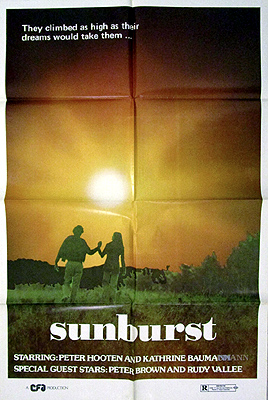
 Sunburst / Slashed Dreams (1975) **
One easily overlooked side effect of focusing as I do on horror, sci-fi, and fantasy films is that it’s possible for hugely important movements in the development of cinema as a whole to escape discussion here almost entirely, because they made little or no recognizable impact on those genres. Maybe the biggest of those omissions so far has been the three-decade, multi-media vogue for stories about men struggling and mostly failing to cope with perceived challenges to their masculinity, stemming from the interaction between modernity and the various turning points in an individual life. Being the kind of snide bastard that I am, I think of this phenomenon— which was one of the dominant currents of mainstream literature, drama, and film from the mid-1940’s through the late 1970’s— as the Great Mid-Century Penis Chase.
This is the kind of nebulous cultural formation for which it’s easier to list examples than to state defining principles. The Great Mid-Century Penis Chase encompasses everything from Death of a Salesman to The Swimmer to 20,000 tediously interchangeable novels about pushing-50 college professors banging their students. It doesn’t need to involve mid-life crises, though. There’s an equally significant young man’s version that switches out the anxieties of waning patriarchal status for those attendant upon establishing it in the first place, and which tends to combine elements of the conventional coming-of-age tale with the picaresque. A fair amount of beat and proto-hippy literature operates in that mode, from On the Road on down. But until I watched Sunburst, it never occurred to me that it was possible to situate Straw Dogs and Deliverance within the Great Mid-Century Penis Chase as well.
It’s very strange that Sunburst, of all things, should lead me to that revelation, not only because its focal character is a girl, but also because this movie often seems to be deliberately refuting the other two’s conflation of masculine potency with the capacity for lethal violence. Nevertheless, on the level of mere plot, Sunburst owes a great deal to both Straw Dogs and Deliverance, even if its philosophical concerns have more to do with post-60’s disappointment than with reclaiming the phallus at rifle-point. The aforementioned girl is named Jenny (Katherine Baumann, from Chrome and Hot Leather and The Thing with Two Heads), and she’s a college student somewhere in the northern half of California. Her best friend since childhood is a guy called Robert (Peter Hooten, of A Woman for All Men and Fantasies), but while he clearly has deeper feelings for Jenny, she’s romantically attached to Marshall (Ric Carrott, from The Swinging Cheerleaders) instead. Neither Jenny nor Robert is a hippy exactly, but they both cling longingly to what they imagine having been the meaning of a movement they were born just a little too late to be part of. Marshall, on the other hand, could be the villain in an Animal House ripoff made a few years later than Sunburst, or the hero in a Risky Business ripoff made a few years later still. He and his fraternity brothers have only sneering contempt for idealism of any kind; they’re out to get ahead, aspiring to mesh as perfectly as possible with all the other gears in the business machine.
One day, Jenny gets a letter from Mike Sutherland (Robert Englund, of Mind Over Murder and Freddy vs. Jason), another friend of hers and Robert’s from back home. Several years the kids’ senior, Mike really did turn on, tune in, and drop out— all the way out to a handmade cabin in the woods someplace near the Oregon state line. Mike represents everything that Marshall considers foolish and outmoded, and learning of the letter provokes the frat boy to a days-long tantrum of assholism. (I can’t help noticing, though, that Marshall’s behavior seems motivated as much by jealousy as by anti-hippy sentiment. He plainly doesn’t like that Jenny’s old friendship with Mike is something that she shares with Robert, and not with him.) Over the course of those days, Jenny and Robert get it into their heads to pay a visit to Mike at his woodland hermitage sometime. And when Marshall makes an absolutely intolerable prick of himself at a fraternity party attended by both Jenny and Robert, the girl decides that “sometime” might as well be now. Marshall tries to put a stop to that, chasing after the pair with a pack of his lunkhead friends, running them off the road, and making clear his intention to beat the stuffing out of Robert unless Jenny switches cars at once. Another partygoer named Tina (Anne Lockhart, from Dark Tower and Troll) intervenes to stop the pummeling before it starts, however, and Jenny tells Marshall in no uncertain terms that the two of them are through.
I was pretty sure I knew where Sunburst was going at this point. Obviously Marshall was going to pursue Jenny and Robert into the mountains, getting more and more pissed off and jealous as the pair’s friendship blossomed into love at last. Eventually some final straw would provoke him into leading some goons from his frat in a gang rape, and then Robert and Mike would team up to avenge Jenny, peace, love, and Aquarian ideals be damned. But in fact I was wrong on every count save the basic fact that a rape was in the offing. Indeed, Marshall, the frat, and the whole-ass college will never be seen again! The first hint toward my error came from, of all directions, the washed-up 1930’s radio star who runs the general store from which Mike posted his letter to Jenny, played by real-life washed-up 1930’s radio star Rudy Vallee. The shopkeeper tries very hard to dissuade the kids from continuing on up the ridge into the forest, and when that doesn’t work, he tries equally hard to sell them a Rambo-sized hunting knife. So clearly whatever danger lurks in those woods has been there a while, independent of Jenny’s romantic travails.
It takes until late the following morning for Jenny and Robert to find Mike’s cabin, and there’s no sign of the hermit himself when they arrive. Meanwhile, their own lakeside campsite from the night before has drawn the attention of Levón (Eviltown’s James Keach— Stacy’s less famous brother) and Danker (David Pritchard, of The Curious Female), two modern-day mountain men whom I take to be GIs who came back wrong from Vietnam. (Keach and Pritchard also wrote Sunburst, which makes it interesting that they’d cast themselves as its major villains.) Imagine those guys’ excitement that afternoon, when they return to the lake to catch Jenny and Robert skinnydipping together. The couple (as I think we can correctly call them by this point) talk their way out of any trouble on that first occasion, but Levón and Danker spend the whole rest of the day thinking about what they didn’t quite see of Jenny below the water’s surface. Come nightfall, they’ve worked themselves up into the kind of state in which a man becomes capable of almost anything. The two creeps let themselves into Mike’s cabin (the door doesn’t lock, of course) just as their targets are drifting off to sleep, and beat Robert senseless before turning their attention to the girl. Levón is too drunk to finish what he starts with Jenny, but Danker is evidently better at holding his liquor.
Morning finds Jenny nearly catatonic, and Robert sick with shame and self-loathing over his inability to protect her. Fortunately, Mike picks that moment to show his face at last; turns out he’d been off gathering wild herbs all weekend. Mike’s arrival is fortuitous for several reasons. First of all, it means that Robert and Jenny won’t have to pick up the pieces from last night all by themselves. It also means that they’ll enjoy the benefits of whatever folk medicine Mike has taught himself up in those mountains, which is surely most welcome under the circumstances. But perhaps most importantly, Mike is someone whom Jenny trusts, who hasn’t brought discredit and disgrace on himself, real or imagined, by failing to save her from being raped. On the one hand, that puts Mike in a position to nurture the girl back out of her defensive crouch, untroubled by worries that he’s somehow unworthy to do so. And on the other, it puts Robert in a position to set out on a quest for redemptive revenge without leaving Jenny unguarded.
What makes Sunburst truly bizarre is what happens when Robert catches up to Levón and Danker. There is a confrontation, and that confrontation does descend into violence, but it rapidly becomes apparent that none of the combatants quite have their hearts in the fight. Robert, in the final assessment, lacks the stomach for killing, while killing is the very thing that Levón came to the mountains to leave behind. Indeed, immediately before Robert strikes, Levón and Danker fall to fighting over the latter’s desire to have another go at Jenny, and Levón ends up hamstring his friend in order to keep him from carrying out his plan when he won’t listen to reason. Meanwhile, the indecisive clash in the woods is juxtaposed against what feels like the true climax to the film, as Mike and Jenny talk over the rape in search of some way that she can learn to live with her victimization. Those two reach their breakthrough just as Robert starts to gain the upper hand over Levón, after which Jenny and Mike rush out to break up the fight on the mountaintop. And incredibly, the last thing we see is Jenny and Robert, reconciled both to each other and to the experiences of the past several days, holding hands in the light of the setting sun as they begin their descent toward the bottom of the ridge and the rest of their lives.
Perhaps you can see, then, why I’ve preferred Sunburst’s original title over Slashed Dreams, even though the latter name is by far the one under which you’re more likely to encounter this movie today. Slashed Dreams was imposed on the mid-80’s home video release in a clumsy gambit to exploit Robert Englund’s newfound stardom in the Nightmare on Elm Street series, but Mike Sutherland couldn’t possibly be more unlike Freddy Krueger. Looking back from 2026 (or even from 1987!), it’s a real mindfuck to see Englund cast as a wise and kindly hippy who reveals his greatest wisdom when he admits that he’s just making it all up as he goes along like everyone else. I’m sure this movie has disappointed everyone who ever saw it under the misapprehension that it was Robert Englund’s first horror film, because it resembles that only if you squint really hard and use only your peripheral vision.
But even if you understand what Sunburst actually is, it’s mostly just bewildering. For one thing, although I’ve been relating to it primarily as Jenny’s story, I’m not entirely sure it was supposed to be. Partly it’s the Straw Dogs-Deliverance connection making me wonder, but it’s also the contrast between Katherine Baumann’s performance and Peter Hooten’s. Hooten is such a sluggish nonentity that I can’t help asking if maybe he’s just getting blown off the screen by Baumann, so that she seizes the protagonist’s mantle for Jenny by default. That could also explain the unexpected relative weights of Marshall’s fight with Levón and Jenny’s DIY psychotherapy session with Mike. Perhaps the latter feels so much more significant than the former because Baumann and Englund are selling the shit out of their scene, while Hooten and James Keach aren’t.
The overall construction of Sunburst is peculiar, too, both in ways that are just plain amateurish and in ways that point toward the film’s parallelism with the Great Mid-Century Penis Chase. Entries in that metagenre aimed at and concerning young people tend to be highly episodic, so it’s possible that Sunburst’s three acts are about three totally different things as a deliberate effort to duplicate that quality. Or alternately it could simply be that James Keach and David Pritchard didn’t know what the fuck they were doing as writers. Either way, the fact remains that Sunburst begins as a melodrama about shifting social values viewed through the prism of a dysfunctional relationship, transforms into a romance in which a girl and a boy find themselves by finding each other, and then warps once again into a rape-revenge movie that ends by repenting of rape and disavowing revenge. And then tying it all together with ever-increasing tonal inaptness is the saccharine, subtext-literalizing crooning of Roberta Van Dere, a cut-rate Joan Baez wannabe. All told, Sunburst is the movie for you if you’ve ever wished you could watch a first novel that won lukewarm praise from the New York Times Book Review, by an author who went on to never write a second one.

Home Alphabetical Index Chronological Index Contact
