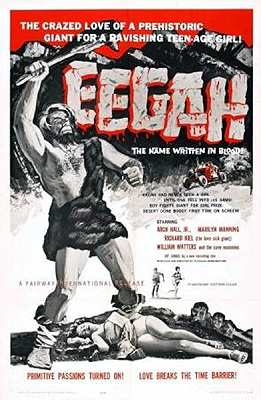
 Eegah (1962) -**
The last time we saw Arch Hall Jr. and his namesake dad around here, it was in The Sadist, by far their best movie, and frankly the only one of the bunch that’s worth a shit. Indeed, The Sadist has hitherto been our only encounter with the Arches Hall! That simply won’t do. It’s completely unacceptable to have such a justly infamous pair of cinematic miscreants go represented solely by a unique outlier among their work, so let’s look now at something a little closer to the center of the distribution.
To recap a bit, since it’s been so very long, Arch Hall Sr. was a character actor who spent the 30’s and 40’s playing minor supporting roles in even more minor B-Westerns. His son, on the other hand, was an aspiring rock-and-roller, and as the 50’s gave way to the 60’s, Arch Sr. came out of showbiz retirement as a producer-director with the aim of making the kid happen. After all, wasn’t it a big boost to Elvis Presley’s career when he headlined Love Me Tender, Loving You, and Jailhouse Rock? Any attempt to replicate that model with Arch Jr. would labor under several handicaps, however. For starters, there was the matter of money. Even that first crop of Elvis movies had big-studio backing behind them, but raising the $15,000 that Arch Sr. spent making Eegah required hocking just about everything he owned that was worth anything. Then there was the niggling little objection that Junior wasn’t much of a singer, even by the forgiving standards of rock and roll. Also, at a time when teen culture had the attention span of a gnat, his music sounded a lot more like 1956 than 1962. Nor could Arch Jr. play the kind of teen-heartthrob role that most of his movies cast him in with any persuasiveness or conviction. And perhaps most fatally, all things considered, Arch Hall Jr. had a face made for radio. When “Mystery Science Theater 3000” tackled Eegah, they dubbed him “Cabbage Patch Elvis,” and I don’t think I can do better than that. No high school girl was ever going to cut his picture out of a magazine to hang on her bedroom wall, okay? But while the Halls may have been thinking about the early Elvis movies in terms of their career impact, their own films mainly followed a pattern closer to that of the ones Presley made in the 60’s, after he returned from his stint in the army. Although most Arch Hall pictures went out of their way to create excuses for Junior to sing and play guitar, only Wild Guitar was actually about his character’s musical aspirations. The Choppers, for example, was about stealing cars. The Nasty Rabbit was a spy spoof involving a bunny infected with a deadly synthetic plague. And in Eegah, the A-plot has Arch Jr.’s girlfriend getting kidnapped by a giant, horny caveman.
The girlfriend in question is Roxy Miller (What’s Up Front’s Marilyn Manning, whose relationship with Arch Hall Jr. had an altogether darker complexion in The Sadist), daughter of pulp adventure writer Robert I. Miller (Arch Hall Sr., hiding behind the pseudonym, “William Watters”— a different alias from the one he used in his capacity as producer-director to disguise the nepotism at the core of Eegah). While putting her little Austin Healey roadster through its paces on the road past Deep Canyon and Shadow Mountain, Roxy narrowly avoids running down the aforementioned giant caveman (Richard Kiel, from House of the Damned and The Phantom Planet) dragging a freshly killed pronghorn back to his lair. Both parties are too freaked out by the encounter to do much about it for a moment, but the prehistoric hulk is quicker to regain his composure. Indeed, he’s plainly fixing to abduct the girl when he gets scared off by the approach of a second car. And luckily for Roxy, that car belongs to her boyfriend, Tom Nelson (Arch Hall Jr.), with whom she was supposed to be meeting her father and a friend of his for dinner at the Ocatillo Lodge that evening. Tom isn’t entirely sure that he believes his girlfriend’s story about a fur-clad, club-wielding giant, but it’s clear enough that she’s genuinely rattled about something.
The following morning, Roxy leads both father and boyfriend back to the scene of the incident, and sure enough, there are footprints all over the soft ground beside the road that could have been made only by a man of freakishly immense stature. What’s more, the tracks lead into the canyon in the direction of Shadow Mountain— a virtually unexplored place where a feral brute-man could plausibly live unnoticed by the outside world. His scientific curiosity and writer’s instincts both piqued, Miller hires his chopper pilot friend, Kruger (Lloyd Williams, of Cemetery Gates), to fly him out to Shadow Mountain for a few days of searching. Robert figures he’ll photograph the footprints, make a survey of some abandoned campsites, maybe even get a blurry snapshot or two of the giant himself if he’s really lucky. The last thing he expects is a close-quarters run-in with the creature— let alone one that ends with him getting dragged back to the giant’s well-concealed lair.
That lair is a cave high up on the mountain, containing a cold spring from which strange and stinky yet obviously drinkable water flows at a steady trickle. It also contains who knows how many mummies of the giant’s ancestors, to which he regularly speaks in a guttural, syntactically simple language. But the most immediately relevant feature of the cave for Miller’s purposes is the humongous boulder that serves as its front door. The giant— which Miller comes to think of as “Eegah,” after one of his more frequent utterances— has no trouble rolling it back and forth, but Robert needn’t even try in order to recognize that he wouldn’t be able to budge that rock an inch. Obviously Miller will be hanging around the cave for however long Eegah wants him to stay.
Now Kruger was supposed to pick Miller up at the mouth of Deep Canyon in three days, but his helicopter breaks down before he can keep his end of the rendezvous. It therefore falls to Roxy to collect her dad, to which end she has Tom drive her out to the canyon in his homemade dune buggy. Robert, of course, is nowhere to be found at the appointed time, and by hanging around the canyon into the night waiting for him, the kids bring themselves to Eegah’s attention. The giant is interested in Tom only insofar has he’s an obstacle to making off with Roxy (You see? Not even refugees from the Ice Age wanted Arch Hall Jr.!), and the lad is left to scour the canyon and mountain for Eegah’s lair after her capture. The good news is, that puts Tom in at least some position to effect a rescue once Roxy and her father spot an exploitable chance for a breakout. The bad news is, Eegah proves far less willing to settle for the company of mummies after he’s spent some time with a real, live girl. The inhabitants of Palm Springs may have had a hard time finding their way to Eegah’s cave all these centuries, but the brute-man has no trouble at all reaching their turf in pursuit of Roxy.
Eegah just might be the strangest film in the Arch Hall Jr. oeuvre. Any one-line description of its plot or premise makes it sound like a belated 1950’s monster movie, and it isn’t not one of those. But because it’s also a vehicle for a wannabe rock star, the actual experience of watching it is very different. We spend a lot of time listening to Tom croon stylistically obsolete love songs titled after girls whose names start with “V,” and almost as much time watching him (or more likely his stunt double) zipping around the desert in the weirdest custom job on an old flathead Ford that I’ve seen yet. The mix of disparate elements closely resembles The Giant Gila Monster, except that Eegah isn’t nearly as well or thoughtfully constructed as that film.
To be fair, Eegah does have a few genuine virtues. The opening credits, which play out somewhat artfully among the prop mummies that we’ll be seeing later in the giant’s cave, promise a much better and more cinematographically creative film than we actually get. The mummies themselves are even pretty good, obviously made by people who’d seen the real thing at carnival sideshows and the like. Marilyn Manning is as effective in the part of Roxy as the script will allow her to be, and has believable filial chemistry with Arch Hall Sr. She gets to be surprisingly sexy, too, for 1962, absolutely rocking the black bikini that she wears while Tom serenades a gaggle of poolside girls with “Vicky.”
But then there’s… well, just about everything else. Roxy and her dad’s captivity drags listlessly on to very little purpose, and as your mind wanders in search of anything better to do, you start asking questions about things like why all of this is happening now. Although Miller posits the mineral spring in Eegah’s cave as a possible reason for his unnatural longevity, and although the ruggedness of the surrounding countryside explains why the people of Palm Springs have never found their way to his lair, Arch Sr. and co-writer Bob Wehling never try to account for what brought the giant down to the highway for his initial encounter with Roxy. Even more puzzling are the two occasions when we seem to be invited to interpret Eegah as the last of the Nephilim— one of which attributes the line about “giants in the Earth in those days” to a verse of Genesis that literally doesn’t exist! Tom accomplishes shockingly little over the course of the film outside of driving the getaway vehicle for the Millers’ second-act escape. Hell, the climax bewilderingly catches him in the middle of an irrelevant donnybrook with one of his own bandmates over which one of them gets to dance with Roxy! Roxy’s attitude toward the caveman is supposed to evolve along something like the “Beauty and the Beast” pattern, but Marilyn Manning doesn’t have enough to work with to make that believable, and everything she tries bounces ineffectually off the inert mass of Richard Kiel’s performance. And Eegah’s mosey of terror through Palm Springs is put together all wrong, conveying no sense of tension, danger, rising action, or even mere time and space. Most damningly, the giant ends up crashing two different pool parties happening concurrently, while the camera cuts back and forth between them. For the longest time, I couldn’t figure out why none of the people watching Tom’s band play beside one hotel swimming pool seemed to notice Eegah tossing a bunch of galoots led by Ray Dennis Steckler into the other. Much like its star’s unfortunate countenance, Eegah is unsettlingly misproportioned, with too much of some things, not enough of others, and nothing in quite the right place.

Home Alphabetical Index Chronological Index Contact
